Showing posts with label 2014. Show all posts

Tuesday, October 7, 2014

ஃபிளிப்கார்ட்டின் பிக் பில்லியன் டே!!! வாடிக்கையாளர்களைக் கவரும் திட்டம் மிகுந்த ஏமாற்றமாம்


Catchy Advertisements
பிக் பில்லியன் டே!!! அப்படின்னா என்ன?

அது என்ன பிக் பில்லியன் டே?? ஃபிளிப்கார்ட்டின் வாடிக்கையாளர்களை கவரும் திட்டம் தான் பிக் பில்லியன் டே.

‘பிக் பில்லியன் டே' என்ற ஃபிளிப்கார்ட்டின் தள்ளுபடி விற்பனை திட்டம் 06 அக்டோபர் 2014 திங்கள்கிழமை அன்று காலை 8 மணிக்கு தொடங்கியது. 50 சதவீதம் வரை தள்ளுபடியில் பொருட்களை ஆன்லைன் மூலம் வாங்கலாம் என ஃபிளிப்கார்ட் அறிவித்திருந்தது, சில பொருட்களை ஒரு ரூபாய்க்கு வாங்கலாம் என்பதும் கவர்ச்சியான ஒரு அறிவிப்பு எனலாம்.

அமேசான் நிறுவனத்தின் 2 பில்லியன் டாலர் முதலீட்டு திட்டத்தை சமாளிக்கவும், அலிபாபா நிறுவனத்தின் இந்திய சந்தை முயற்சிகளுக்கு எதிராக உருவாக்கப்பட்டது தான் பிளிப்கார்ட் நிறுவனத்தின் பிக் பில்லியன் டே தள்ளுபடி விற்பனை திட்டம்.

சென்ற ஒரு வார காலத்துக்கும் மேலாக ஃபிளிப்கார்ட் இது பற்றி பரபரப்பாக விளம்பரம் செய்து வந்தது. ஃபிளிப்கார்ட் நிறுவனர்கள் தங்கள் வாடிக்கையாளர்களுக்கு இ-மெயில் மூலமும் தகவல் தெரிவிக்க ஏற்பாடு செய்தார்கள்.

ஃபிளிப்கார்ட் எதிர்பார்த்த அளவுக்கு ஆன்லைன் வர்த்தகம் சூடு பிடித்ததா?

அது தான் இல்லை! விளம்பரங்களைப் பார்த்து வாடிக்கையாளர்கள் இணையதளத்தை ஒரே நேரத்தில் முற்றுகைப்படுத்தவே இணையதளம் முடங்கியதாம். சரி இணையதள இணைப்புக் கிடைத்தவர்களாவது தள்ளுபடி விலையில் பொருட்களை ஆன்லைனில் வாங்கினார்களா? இல்லவே இல்லையாம். மிகுந்த ஏமாற்றமாம். இவர்கள் விரும்பிய பொருட்களும் விற்றுவிட்டபடியால் ஸ்டாக் இல்லை என்று அறிவித்திருக்கிறார்கள். இவர்களுக்கும் மிகுந்த எரிச்சல். எனவே தங்கள் ஆதங்கத்தை பல சமூக வலைதளங்களில் பதிவு செய்துவிட்டனராம்.

யார் இந்த ஃபிளிப்கார்ட்?

ஃபிளிப்கார்ட் இந்தியாவின் மிகப்பெரிய ஆன்லைன் சில்லறை விற்பனை நிறுவனம் மற்றும் இணையதளம். ஃபிளிப்கார்ட் சச்சின் பன்சால் மற்றும் பின்னி பன்சால் என்ற இரு ஐ.ஐ.டி பட்டதாரிகளால் 2007 ஆம் ஆண்டு தொடங்கப்பட்டது. நாலு லட்ச ரூபாய் முதலீட்டில் ஃபிளிப்கார்ட்டை தொடங்குவதற்கு முன்பு இவர்கள் அமேசான் நிறுவனத்தில் பணிபுரிந்தார்கள். தகுந்த திட்டமும் உழைப்பும் மட்டுமிருந்தால் எந்த வணிகத்தையும் திறம்படச் செய்யலாம் என்பதற்கு இவர்கள் நல்ல எடுத்துக்காட்டு என்கிறார்கள். தொடக்கத்தில் 18 மாதங்களுக்கு இவர்கள் எந்தவித சம்பளமும் பெறாமல் உழைத்தார்களாம். வென்சர் கேபிடல் என்ற நிறுவனம் கூட இவர்கள் நிறுவனத்தில் முதலீடு செய்வதற்கு ஆயத்தமாய் இருந்ததாம்.

ஆன்லைன் வணிகத்தில் கிரெடிட் அல்லது டெபிட் கார்டுகளை நம்பியே தங்கள் விற்பனையை நடைமுறைப்படுத்தியிருக்கிறார்கள். ஆன்லைனில் பொருட்களை வாங்குவதற்கு இந்த நடைமுறை முட்டுக்கட்டையாக இருந்து வந்துள்ளது. எனவே ஃபிளிப்கார்ட் கேஷ் ஆன் டெலிவரி திட்டத்தை 2010-ம் ஆண்டு அறிமுகப்படுத்தியிருக்கிறார்கள். மிகவும் ரிஸ்க்கான இத்திட்டம் துணிச்சலாக அறிமுகப்படுத்தப்பட்டு மிகப் பெரிய வெற்றியைக் குவித்தது என்று தெரிகிறது. 

வென்சர் கேபிட்டல், அக்செல், டைகர் குளோபல், நாஸ்பர், மார்கன் ஸ்டேன்லி உள்ளிட்ட பல நிறுவனங்கள் பிளிப்கார்டில் முதலீடு செய்திருக்கின்றனவாம். கடந்த ஏழு வருடங்களில் 176 கோடி டாலர் அளவுக்கு ஃபிளிப்கார்டில் முதலீடு செய்யப்பட்டிருக்கிறது. உலகளவில் அதிகளவு முதலீட்டை திரட்டிய இந்திய நிறுவனம் பிளிப்கார்ட்தான் என்கிறார்கள். இப்போது ஃபிளிப்கார்ட்டில் மட்டுமே கிடைக்கும் என்று விளம்பரப்படுத்திப் பொருள்களை விற்க ஆரம்பித்திருக்கிறது. இந்த நடைமுறையில் அதிக அளவில் தள்ளுபடி கொடுக்க முடிகிறது என்கிறார்கள். 

இந்தியாவில் இணையதளத்தை பதினைந்து கோடிக்கும் மேலானவர்கள் பயன்படுத்திய போதிலும் வெறும் பத்து சதவீதத்தினரே ஆன்லைன் மூலம் பொருட்களை வாங்கும் பழக்கமுள்ளவர்கள் என்று ஒரு சர்வே கூறுகிறது. இந்த நிலை படிப்படியாக உயரக்கூடும். வரும் 2020 ஆண்டு இந்த ஆன்லைன் வணிகம் 7000 கோடி டாலராக உயரக்கூடும் என்பது ஒரு கணிப்பு.

Reference

ஃபிளிப்கார்ட் தள்ளுபடி விற்பனை: இணையதளத்தை முற்றுகையிட்ட வாடிக்கையாளர்கள்  தி இந்து October 7, 2014

Monday, October 6, 2014

லில்லி தாமஸ் யார்? செல்வி.ஜெயலலிதா தமிழக முதல்வர் பதவி இழக்க என்ன செய்தார்?

லில்லி தாமஸ்

‘லில்லி தாமஸ்' மற்றும் ‘லில்லி தாமஸ் வழக்கு’ போன்ற சொற்கள் தற்சமயம் செய்தித் தாள்கள் மற்றும் டி.வி சேனல்களில் அடிபட்டுக் கொண்டிருக்கின்றன. இதன் பின்னணி என்ன? யார் இந்த லில்லி தாமஸ்?  கேரளாவின் கோட்டயத்தைச் சேர்ந்த லில்லி தாமஸ் ஒரு உச்சநீதிமன்ற வழக்கறிஞர். பரபரப்பான பெங்களூரு சிறப்பு நீதிமன்ற தீர்ப்பின் காரணமாக, சட்டப்பேரவை உறுப்பினர் மற்றும் முதல்வர் பதவிகளை அதிமுக பொதுச் செயலாளர் செல்வி ஜெயலலிதா இழந்துள்ளார் என்றால் அதற்கு இந்த லில்லி தாமஸ் (எஸ்.என்.சுக்லாவுடன் இணந்து) உச்சநீதிமன்றத்‌தில் தொடுத்த பொதுநல வழக்கினை விசாரித்து 10.7.2013 அன்று உச்ச நீதிமன்றம் பிறப்பித்த வரலாற்றுச் சிறப்புமிக்க தீர்ப்பே காரணம். அது என்ன வழக்கு? இத்தீர்ப்பில் அப்படி என்ன வரலாற்றுச் சிறப்பு இருக்கிறது? அரசியல் வாதிகளை, குறிப்பாக நாடாளுமன்ற, சட்டமன்ற மற்றும் சட்ட மேலவை உறுப்பினர்களை கிலியடைய வைத்துள்ளதென்றால் அது வரலாற்றுச் சிறப்பு மிக்கது தானே. ஆமாம். குற்ற வழக்குகளில் இரண்டாண்டுகளுக்கு மேல் தண்டனை பெற்ற நாடாளுமன்ற, சட்டப்பேரவை உறுப்பினர்கள் மக்கள் பிரதிநிதித்துவச் சட்டம் பிரிவு 8 (1), 8 (2), மற்றும் 8 (3) படி உறுப்பினர் தகுதியை உடனடியாக இழப்பது பற்றிய தீர்ப்பு என்றால் கிலியடையத்தானே வேண்டும்.

குழப்பமாய் இருக்கிறதா? சற்று பொறுமையாகப் படித்தால் எளிதாகப் புரிந்து கொள்ளலாம்.

மக்கள் பிரதிநிதித்துவச் சட்டம் 1951 இந்தியபாராளுமன்றதால் இயற்றப்பட்ட சட்டம் ஆகும். இந்திய நாடாளுமன்றம் மற்றும் மாநிலங்களின்  சட்டமன்றம் மற்றும் சட்ட மேலவை உறுப்பினர்களுக்கான தேர்தல் நடத்துவது பற்றியும், இவ்வமைப்புகளில் உறுப்பினர்களின் தகுதி மற்றும் தகுதியின்மை பற்றியும்,  தேர்தலில் தொடர்புடைய லஞ்சம் மற்ற குற்றங்கள் அது தொடர்பான பிணக்குகள், ஊர்ஜிதமான சந்தேகங்கள் பற்றியும் சட்ட வரையறையை வகுத்துள்ளது.

மக்கள் பிரதிநிதித்துவச் சட்டத்தின் 8-வது பிரிவில் நாடாளுமன்ற, சட்டமன்ற மற்றும் சட்ட மேலவை உறுப்பினர்களில் யாரேனும் குற்ற வழக்குகளில் தண்டனை பெற்றால், அவர்கள் உறுப்பினர் தகுதியை இழப்பது பற்றிய விதிமுறைகள் வகுக்கப்பட்டுள்ளன.

இந்த சட்டப் பிரிவுகளின்படி, 1. மனநலம் பாதிக்கப்பட்டவர்கள், 2. கடன் பிரச்சினையால் திவால் ஆனதாக அறிவிக்கப்பட்டவர்கள், 3. தேசியக் கொடியை அவமதிப்பு செய்தவர்கள், 4. வெளிநாட்டு குடியுரிமை பெற்றவர்கள், 5. தீவிரவாத செயல்களில் தொடர்பு, 6. பலாத்காரம் போன்ற பெண்களுக்கு எதிரான குற்றம், 7. மக்களிடையே மத வேற்றுமையை தூண்டி கலவரம் ஏற்படுத்துவது, 8. போதைப்பொருள் தொடர்பான குற்றங்கள், 9. தேர்தலின்போது வாக்குச் சாவடிகளை கைப்பற்றுதல், 10. வாக்குச் சீட்டுகளை அள்ளிச் செல்லுதல் போன்ற குற்றங்கள் மற்றும் 11. ஊழல், 12. முறைகேடு போன்ற குற்றங்களுக்காக தண்டனை பெற்றவர்கள் நாடாளுமன்ற, சட்டமன்ற மற்றும் சட்ட மேலவை உறுப்பினராக பதவியில் தொடர முடியாது என்று மக்கள் பிரதிநிதித்துவச் சட்டத்தின் பிரிவு 8-ல் அடங்கியுள்ள (1), (2), (3) ஆகிய உட்பிரிவுகளில் கூறப்பட்டுள்ளது.

மேலே சொல்லப்பட்ட குற்றங்களுக்காக தண்டனை பெற்றவர்கள், கீழ் நீதிமன்றங்களால் தண்டனை அறிவிக்கப்பட்ட உடனேயே பதவியில் தொடர்வதற்கான தகுதியை இழப்பதோடு, தண்டனை முடிந்த பிறகும் அடுத்த 6 ஆண்டுகள் வரை தேர்தலில் போட்டியிட முடியாது என இந்த பிரிவுகளில் தெளிவாக கூறப்பட்டுள்ளது.

சரி அப்படியென்றால் இந்த தீர்ப்பு உச்சமன்றத்தால் பிரகடனப்படுத்துவதற்கு முன்பு, அதாவது 10.7.2013 க்கு முன்புவரை யாரும் பதவி இழந்ததாகத் தெரியவில்லையே ஏன்?

காரணம் இச்சட்டத்தின் 8-வது பிரிவின் (4)-வது உட்பிரிவு ஆகும். விசாரணை (கீழ்) நீதிமன்றத்தால் தண்டனை பெற்றாலும் கூட உடனடியாகப் பதவி இழக்காதபடி நாடாளுமன்ற, சட்டமன்ற மற்றும் சட்ட மேலவை உறுப்பினர்களுக்கு 10 ஜூலை 2013 தேதிவரை பாதுகாப்பு அளித்து வந்துள்ளது. விசாரணை (கீழ்) நீதிமன்றத்தால் தண்டனை பெற்ற தேதியிலிருந்து 90 நாட்களுக்குள் தண்டனையை எதிர்த்து மேல் நீதிமன்றங்களில் முறையீடு செய்யும் எம்.பி., எம்.எல்.ஏ.க்கள் தங்கள் பதவிகளை இழக்க மாட்டார்கள் என்ற பாதுகாப்பு தான் இது. இச்சட்ட உட்பிரிவு தந்த பாதுகாப்பால் குற்ற வழக்குகளில் தண்டனை பெற்ற பல எம்.பி., எம்.எல்.ஏ.க்கள் தொடர்ந்து தங்கள் பதவிகளை அனுபவித்து வந்தனர்.

இந்த சட்ட உட்பிரிவு அரசியலமைப்புச் சட்டத்துக்கே விரோதமானது எனவும் 8 (1), 8 (2), மற்றும் 8 (3) உட்பிரிவுகளுடன் முரண்பாடுகள் கொண்டது என்றும் சட்டப்பிரிவு 8 (4) பிரிவு செல்லாது என அறிவிக்கக் கோரி கடந்த 2005-ம் ஆண்டு உச்ச நீதிமன்றத்தில் லில்லி தாமஸ், எஸ்.என்.சுக்லா என்ற 2 பேர் பொது நல மனுக்களை தாக்கல் செய்தனர்.

மனுக்களை முறையாக விசாரித்த பின் உச்ச நீதிமன்றம் எட்டு ஆண்டுகளுக்குப் பிறகு வரலாற்றுச் சிறப்புமிக்க தீர்ப்பை 10.7.2013 அன்று பிரகடனப்படுத்தியது.மனுதாரர்களின் கோரிக்கை நியாயமானது என்றும் மக்கள் பிரதிநிதித்துவச் சட்டத்தின் 8 (4)-வது பிரிவு அரசியலமைப்புச் சட்டத்துக்கே விரோதமானது என்றும், அந்த சட்டப்பிரிவு செல்லாது என்றும் பிரகடனம் செய்தது.

உச்ச நீதிமன்றத்தின் இந்த அதிரடி தீர்ப்பால் நாட்டில் ஐந்து பேர் இது வரை தங்கள் பதவிகளை இழந்துள்ளனர். இவர்களில் ராஷ்டிரிய ஜனதா தள தலைவர் லாலு பிரசாத் யாதவ், அதிமுக மாநிலங்களவை உறுப்பினர் டி.எம்.செல்வகணபதி உட்பட ஐந்து பேர் தங்கள் பதவிகளை இழந்தனர்.  தற்போது ஆறாவதாக சட்டப்பேரவை உறுப்பினர் மற்றும் முதல்வர் பதவிகளை அதிமுக பொதுச் செயலாளர் செல்வி ஜெயலலிதா இழந்துள்ளார்.

திருமணமாகாத லில்லி தாமஸூக்கு தற்போது 87 வயதாகிறது. பள்ளிப்படிப்பு திருவனந்தபுரம்; சட்டப்படிப்பு சென்னை சட்டக்கல்லூரி; சென்னைப் பல்கலைக்கழகம்; புதுடில்லி நகரில் வசித்து வந்துள்ளார்; 1964 ஆம் ஆண்டு முதல் பல பொதுநல வழக்குகளில் வெற்றி பெற்றுள்ளார். பெங்களூரு சொத்துக் குவிப்பு வழக்கின் தீர்ப்பு வெளியானவுடன் தமிழக மக்கள் தங்கள் கோபத்தை லில்லி தாமஸ் மேல் காட்டிவிடுவார்களோ என்று பயந்து தலைமறைவாக இருந்து வருகிறார். “பதவியில் இருந்த போது ஜெயலலிதா எவ்வளவு பவர்ஃபுல்லாக இருந்தார்? ஆனால் இப்போது? எங்கே போனார்கள் அவர்கள் கட்சித் தொண்டர்கள் எல்லாம்? எதுவும் செய்ய முடிந்ததா? அவரது சொத்துகளை எல்லாம் பறிமுதல் செய்ய வேண்டாமா? நமது சட்டம் இன்னமும் தெளிவாக இருக்க வேண்டும்” என்று இன்னமும் வாதிடுகிறார் லில்லி தாமஸ். அதனால் தானோ என்னவோ இந்த தலைமறைவு வாழ்க்கை இவருக்கு.
India News: Lily Thomas speaks on the decision of the Supreme Court (Youtube)

Monday, September 1, 2014

Inscriptions of Madras: Francis Whyte Ellis - English Civil Servant's Tamil Inscription


The plaque of FW Ellis held at Thirumalai Nayakar Museum at Madurai

FW Ellis made the die block  showing the figure of Thiruvalluvar for minting the East India company coin from the Madras mint. The die block was published by Iravatham Mahadevan.

Francis Whyte Ellis (1777–1819) aka. 'Ellis Durai',  a British civil servant in the Madras Presidency and a scholar of Tamil and Sanskrit, was the first scholar to recognize the Dravidian languages as a separate language family. This Englishman is being considered as great Tamil scholar for his contribution in 'Tamil Prose' writing. 

Life of FW Ellis

Ellis was recruited as a writer East India Company's service at Madras in 1796. The civil servant was elevated to hiher posts in the Board of Revenue i.e, offices of assistant-under secretary in 1798,  deputy-secretary in 1801, Secretary in 1802, judge of the zillah of Machilipatnam in 1806, Collector of Land Customs in 1809 and finally the Collector of Madras in 1810. He died at the age of 41 Ramnad of cholera on 10 March 1819.

The Dravidian Proof

In 1816 his groundbreaking conceptualization of the Dravidian language family of South India known as the “Dravidian proof.” Ellis' Dravidian Proof is a step by step attempt to establish  that the languages of South India are related to one another but are not derived from Sanskrit. These concepts are valid still today, even after centuries later.

College of Fort St. George and College Press

Ellis,  a Member in Madras Literary Society was responsible for founding the College of Fort St. George in 1812 at Madras with Britishers and Indians as registered members. In 1813 he was also  instrumental in setting up of the College Press with a printing press and Tamil type faces. 

The press first published its Tamil book by Constanzo Beschi's (Veeramamunivar) Tamil grammar "Kodum Tamil" in 1813. It also brought out two Tamil books by Chitthambala Desikar -  'Tamil grammar primer Ilakkana surukkam'  and 'Tamil translation of Uttara Kandam of Ramayana.' Ellis' published works include 'Thirukkural: Translation and Commentary' and five Telugu works including Campbell's grammar. The press also continued to publish books in Kannada, Malayalam and Arabic till 1830s.

Tamil as Language for Administration

 As chairman of the committee, Ellis insisted the necessity to learn the basic structure of the South Indian languages by the civil service officers for effective functioning of duties in South Indian villages and towns. He has also taken note of the 'common features of five South Indian "dialects" - High Tamil, Low Tamil, Malayalam, Telugu and Kannada and recommended the teaching of Tamil as a representative of all five.' He also made assigned the College of Fort St. George as well as its press to prepare grammer and some other text books for the 'Language training'.

Thomas R. Trautmann, Marshall Sahlins Professor of History and Anthropology at the University of Michigan, United States and the editor of the journal Comparative Studies in Society and History, was influenced by A.L. Basham and showed interest in Indian studies. Trautmann after publishing three books - Kautilya and the Arthasastra (1971), Dravidian Kinship (1982) and  Invention of Kinship (1985), came to Chennai  on August 19, xxxx to launch another book. He also gave a talk on F.W.Ellis at  Roja Muthiah Research Library (RMRL), Taramani, Chennai and also interacted with Theodore Baskaran, a historian from Chennai.

Thomas R. Trautmann also rediscovered the stone slab with Tamil Inscription by F.W.Ellis. The colonial administration has dug twenty seven wells in 1818 as per the orders of Ellis, then Madras Collector to quench severe drinking water shortage in Madras. Periya Palayathamman temple at Royapettai, Madras being one of these twenty seven wells. Ellis' long inscription appreciated Thiruvalluvar and quoted one of his Thirukural couplet to justify the steps initiated during drought. The Poetical Tamil inscription composed in Asiriyapaa meter is shown below:

எல்லீசன் கல்வெட்டு

சயங்கொண்ட தொண்டிய சாணுறு நாடெனும்
ஆழியில் இழைத்த வழகுறு மாமணி
குணகடன் முதலாக குட கடலளவு
நெடுநிலம் தாழ நிமிர்ந்திடு சென்னப்
பட்டணத்து எல்லீசன் என்பவன் யானே
பண்டாரகாரிய பாரம் சுமக்கையில்
புலவர்கள் பெருமான் மயிலையம் பதியான்
தெய்வப் புலமைத் திருவள்ளுவனார்
திருக்குறள் தன்னில் திருவுளம் பற்றிய்
இருபுனலும் வாய்த்த மலையும் வருபுனலும்
வல்லரணும் நாட்டிற் குறுப்பு
என்பதின் பொருளை என்னுள் ஆய்ந்து
ஸ்வஸ்திஸ்ரீ சாலிவாகன சகாப்த வரு
..றாச் செல்லா நின்ற
இங்கிலிசு வரு 1818ம் ஆண்டில்
பிரபவாதி வருக்கு மேற் செல்லா நின்ற
பஹுதான்ய வரு த்தில் வார திதி
நக்ஷத்திர யோக கரணம் பார்த்து
சுப திநத்தி லிதனோ டிருபத்தேழு
துரவு கண்டு புண்ணியாஹவாசநம்
பண்ணுவித்தேன்

Elleeson Inscriptions

It is me, Elleesan (எல்லீசன்) the resident of city of Chennai Pattinam (Chennai city's colonial name), a part of Jayamkonda Thondiya (Thondai) Naadu (1), the beautiful piece of land, amidst ocean bounded by Western Ghats Hills  (குணகடன்) in the west and eastern (Bay of Bengal) ocean (குட கடலளவு) looking the like sparkling jewels; and while carrying my official duties of Mint Superviser (Employed in the Colonial Madras, Madras Presidency), I got totally absorbed by the real meaning of the classic of couplets or Thirukural composed by Thiruvalluvar (Tamil: திருவள்ளுவர்), a celebrated "Poet's Poet" (புலவர்கள் பெருமான்) aka. Divine Poet (தெய்வப் புலமை) from Mylapore (மயிலையம் பதியான்):

3. Essentials of a State (அங்கவியல்): Chapter 74 The Land (நாடு) - குறள் எண் 737.

Waters from rain and springs, a mountain near and waters thence;
Thee make a land, with fortress' sure defence - The-Sacred Kural by Rev G U Pope

 "இருபுனலும் வாய்ந்த மலையும் வருபுனலும்
வல்லரணும் நாட்டிற் குறுப்பு" - திருக்குறள்

தமிழ் விளக்கம்:

ஆறு, கடல் எனும் இருபுனலும், வளர்ந்தோங்கி நீண்டமைந்த மலைத் தொடரும், வருபுனலாம் மழையும், வலிமைமிகு அரணும், ஒரு நாட்டின் சிறந்த உறுப்புகளாகும்.

I have commissioned 27 wells on an auspicious day confirming beneficial Varam (Solar day), Tithi (Lunar day), Nakshatra (Star Constellation), Yogam (Star and Weekday combination) and Karanam (Half of the part of Tithi) according to Hindu almanac (Panchang); during the English Calendar year 1816; the equivalent Shalivahana calendar year (aka. Saka year) being  1740; and the equivalent Tamil calendar year being  Vehudhanya (வெகுதானிய), the 12th year of  60 years cycle followed in Tamil Calendar system.

1. Jayamkonda Thondiya Naadu: Thondai means very ancient long time back. Naadu means province. Tondai Naadu was an ancient (historical) region of Tamil country located in the northernmost part of Tamil Nadu. The province included traditional Pallava kingdom comprising roughly the present districts of Kancheepuram, Chennai, Tiruvallur, Vellore and Tiruvannamalai. The capital of Thondai Naadu was Kancheepuram.  It was captured by the second Chola monarch, Aditya (r. ca. 871-907). he defeated the armies of the Pallavas of Kanchipuram and claimed all of Tondai Nadu as Chola territory. Therefore the region was known as Jeyamkonda Thondai Nadu)

His tomb at Dindugul bears the following Tamil poems:

'திருவள்ளுவப் பெயர்த் தெய்வம் செப்பிய 
அருங்குறள் நூலுள் அறப்பா லினுக்குத்
தங்குபல நூலுதா ரணங்களைப் பெய்து
இங்கிலீசு தன்னில் இணங்க மொழிபெயர்த்தோன்'.

Meaning: Of the three sections of Thirukural composed by godly poet Thiruvalluvar, I, F.W.Ellis, have translated the first section Righteousness (அறத்துப்பால்) in English after confirming several reference texts.

Reference
  1. Francis Whyte Ellis Wikipedia http://en.wikipedia.org/wiki/Francis_Whyte_Ellis
  2. Mahadevan, Iravatham. "The Golden coin depicting Thiruvalluvar -2". Varalaaru.com (in Tamil)
  3. Venkatachalapathy, A. R. "A Scholar called Ellis". Kalachuvadu Magazine (in Tamil`).

Friday, August 29, 2014

Kattuputhur Excavations: REACH Exhibition and Presentation by Swarnamalya

Kattuputhur Village - Location Map Google
Terracotta heads of Sastha (left) and the Buddha (right) (belongs to a period earlier than the Megalithic Age or Iron Age in Tamil Nadu) found near Kattuputhur (photograph courtesy : K.V. Srinivasan, The Hindu)
Inauguration of the Exhibition on Kattuputhur Excavations - organized by AASAI and REACH Foundation and Rotary Club of Madras Central Aadithya at at Madras Management Association, 3rd Cross St., Seethammal Extn., Teynampet on 24th August 2014 between 10.30 am and 12.30 pm. (photograph courtesy : Dinamalar)
Excavation work at Kattuputhur, Thottiam Taluk of Tiruchirapalli District, yielded five potsherds with Tamil Brahmi script, shallow and deep terracotta bowls and plates, thin black and red ware, miniature pottery, beautiful terracotta figurines of the Buddha and the Sastha, beads made out of conch shells. The artifacts datable to second century CE together  tell a story about how our ancestors lived about 1800 years ago.

The importance of the site, according to T. Satyamurthy, former Superintending Archaeologist, Archaeological Survey of India (ASI) and the founder president of REACH Foundation, Chennai, is that it belongs to a period earlier than the Megalithic Age or Iron Age in Tamil Nadu. They estimate that the site is datable from third century BCE to the 15th century CE.

Kattuputhur, the nondescript village, in Thottiam Taluk,  Tiruchirappalli district, Tamil Nadu near Namakkal, has spread along the north bank of the Cauvery river and populated with 11,115 people.  The perennial river flowing in 3 km distance from Kattuputhur and pouring her blessings on the people and turning the land green and fertile. The finest fertile lands depends mainly on the Cauvery water.

The site comprising huge mound was first identified by Dr.Swarnamalya Ganesh, renowned danseuse, actress, TV anchor and the Board of Trustee of Sri Lalithalayam trust (regd). She has also completed the course in “Deciphering South Indian Inscriptions - Tamil Brahmi, Chola Tamil and Grantham” conducted by the  REACH Foundation. This archaeological enthusiast also discovered and collected  the Sasta, Garuda, Vishnu, Jeshtadevi, Buddha and all other sculptures and photographed it first. She later invited Dr.Satyamurthy, the founder, Rural Education and Conservation of Heritage (R.E.A.C.H) Foundation, Chennai and his team of archaeologists. REACH has obtained license from ASI to conduct excavations and the team laid two trial trenches from April 26 to May 20 (Four-weeks).  The excavation director was Shri. K.K. Ramamurthy, former Superintending Archaeologist, Thrissur Circle, ASI.

Dr.Swarnamalya Ganesh, the Board of Trustee of Sri Lalithalayam trust (regd) is the decendent of the family of Dikshitars of Kattuputhur. The land grant including  of 1000 velis including the villages Kattuputhur, Thottiyam and Valayapatti as a free hold to Dikshitar family by Vijayanagara emperor Sri Krishnadevaraya. The copper plate grant issued by Sri Krishnadevaraya and the book “Sages of Himalayas” by Swami Sivananda confirm this land grant. The Sri Lalithalayam trust (regd), formed by her family with the "lofty ideals of searching the heritage roots of Kattuputhur, establishing a museum, renovation, conservation and restoration of temples, monuments and heritage edifices in and around their village."

REACH has organized an exhibition comprising the collection of photographs and artifacts obtained from the site. This exhibition recognises the ancestral as well as the historical link with the Kattuputhur village. The presentation by Dr.Swarnamalya, preferred to call her as an archaeological enthusiast, highlighted her attachment with her ancestral village. She also brought out the concept of 'Community archaeology' being experimented by REACH and the response from people is encouraging. Her direct involvement in discussions with other archaeologists, researchers, journalists and enthusiasts about the archaeological site and artefacts and it was a "learning from experience" for her. She also interacted well with the skilled and unskilled staff in the excavation process as well as the local people who showed curious reactions and later extended all possible help in the task.

The excavation has produced different varieties of ceramics such as black and red ware. The pottery sherds contain Brahmi inscriptions on them, which have provided additional evidence for the archaeologist to date them to third century BCE. Other artifacts such as shallow and deep terracotta bowls and plates, terracotta figurines of the Buddha and the Sastha, beads made out of conch shells provide clues about the nature of the settlements and the other aspects of life during the ancient Sangam Age Tamilakam.

Dr.Satyamurthy has arrived at a conclusion that the excavation revealed about the flood action from the Cauvery river, first during the second century CE and again in the seventh century CE.

Reference

  1. A chance find of 1,800-year-old artefacts TS Subramanyan The Hindu  July 1, 2014
    http://www.thehindu.com/news/national/tamil-nadu/a-chance-find-of-1800yearold-artefacts/article6164059.ece
  2. Dr Swarnamalya Ganesh: Her Lineage http://drswarnamalyaganesh.com/her-lineage
  3. Heritage Restoration Visits REACH Foundation http://conserveheritage.org/?page_id=1547
  4. ராஜேந்திர சோழன் பிறந்த நாள் குழப்பத்துக்கு தீர்வு தேவை : தொல்லியல் ஆய்வாளர் விருப்பம்  (எஸ் ராமச்சந்திரன்) தினமலர்  25 August 2014
Kattuputhur Archaeological Excavations by REACH Foundation: Exhibition (Youtube Video)

Friday, August 22, 2014

Sculpture Galleries of Government Museum, Chennai: Guided Walk on Sculpture Identification Skills


Management Consultant and History enthusiast, Pradeep Chakravarthy
Hero-stones Gallery at Govt. Museum, Egmore, Chennai
Sculptures @ Pallava Gallery
Lord Vishnu Pallava Sculpture
Dakshnamurthy Pallava
Reclining Vishnu with Sri Devi and Bhu Devi Early Chola
Chola Sculpture
 
 Vijayanagara Emblem
 Mahishasuramardhini - Chola
 Vishnu
Parvati

Management Consultant and History enthusiast, Pradeep Chakravarthy  guided the 45 minute walk on 10th August 2014 between 11.00 and 11.45 am around  select stone sculpture galleries  inside the Government Museum, Egmore Chennai 600008, India. About 30 history buffs  from all walks of life participated in this event.

About Government Museum, Egmore

The walk commenced with a brief introduction about the museum. The Government Museum, established in 1851 under the charge of Dr. Edward Balfour, Medical Officer of the Governor's Body guard, houses India's finest collection of stone and bronze sculptures that span several centuries. Initially it was inaugurated within the first floor of the College of Fort St. George (present DPI premises) with the 1100 geological specimens of the Madras Literary society. The museum was later shifted to the Pantheon building with huge garden spaces in 1854. Previously Pantheon aka Public Rooms or Assembly Rooms was being utilized for banquets, balls and dramatic performances. During 1856, a zoological garden with 360 animals was established within the museum.


Non-Agamic or Non-Vedic Pantheon of Gods

The statue of sun god occupied a center stage (staircase leading to balcony) in the main hall (at the entrance) of the museum. There is a serpent stone gallery on the left and a hero stone gallery on the right. Pradeep preferred to recognize the nature worship (as part of the sun god worship, serpent cult and hero stone worship) as the non-vedic or non-agamic pantheon of gods in Hinduism.  Before temples came into existence,  nature worship - including celestial objects such as the sun and moon and terrestrial objects such as water and fire - formed as a definite and complex system of belief in early South Indian civilizations. The sun worship played an important place even today in Hinduism. Serpent cult (Ophiolatry), Hero stone or Stonehenge (mother goddess worship on chastity counts (i.e, Kannagi, the heroin of Tamil epic Silapathikaram) worship also fall under the  non-agamic pantheon of Hinduism.

The serpent cult or worship of serpents (Ophiolatry) or Naga worship occupied high status in Hindu mythology.  It is considered even today as symbol of fertility and life. In olden times Lord Balarama (brother of Lord Krishna) was recognized as the Lord of snakes. Hero stone (nadukal) is the memorial stone erected between the 3rd century BC and 18th century AD in southern India to commemorate the heroic death of men in battle.  Stonehenge representing the womb of mother goddess or Sati stones (sacred relics of widow sacrifice) also occupied important place in the non-vedic worship.

Select Stone Sculptures

The museum complex comprise six buildings and 46 galleries. It's distinguished art collection includes the stone sculptures of Pallava period (300 - 897 AD.), early Chola period (850 - 985 AD.) medieval Chola period (985 - 1074 AD.), later Chola period (1074 -1350 AD.),  Viajayanagara period (1350 - 1600 AD.) and modern period (From 1600 AD. onwards). It also houses wonderful collection of sculptures of  Chalukya, Hoysala, Rahtrakudas dynasties.

Unique Features for Identification

Pradeep selected the stone sculpture galleries of Pallava period, early, medieval and later Chola periods, Vijayanagara period and modern period as the context for discussion. He analyzed the uniquely distinguishable features of the sculptures one by one commencing from Pallava dynasty.  The Pallava sculptures came into being from the 4th to 9th centuries. The sculpted human figures exhibit plain and simple, realistic anatomy, elongated (oval) faces with large eyes, broad nose with chubby tip, less ornamentation and cylindrical head gear.  The hind limbs  (third and fourth hands) of deities originate from the elbow the hand. Vishnu appear with Prayoga Chakra (discus is twisted in Vishnu's hands and its almost in a form - ready to go). Reclining Lord Vishnu with seated Bhu Devi (with breast band) and Sri Devi (without breast band) located in the Pallava gallery aroused interest.

The medieval Chola sculptures show rigid and artistic anatomy, slightly rounded face, nose with increased sharpness, conical shaped head gear and more ornamentation with detailed patterns. The medieval and later Chola sculptures exhibit shaped anatomy, distinct round face, sharpened nose, rich ornamentation and conically shaped head gear. The Vijayanagara sculptures followed the Chola style of sculpting and gave attention to details. The anatomically realistic sculpture forms of Pallava period evolved into much rigid and artistic  forms. The resource person analyzed the possible reasons.

Temple: From Places of Worship to Socio - Political Institutions

The Pallava kings provided direct  patronage, guidance and funding for the sophisticated agamic temple building and architecture. The medieval Cholas expanded their empire in all directions and became a military, economic and cultural power in South Asia and South-East Asia. They pioneered a centralized form of government and established a disciplined bureaucracy. Local self-govt was a remarkable feature of Chola administration. Temples in grandeur scales were built to commemorate the victories and achievements. They also provided liberal land endowments, gold, jewellery and developed public funds from land revenue and tax collection to the village administration that managed the temple. They either raised small and medium sized granite temples or rebuilt / converted brick structures into granite shrines around Cauvery plains, central and northern Tamil Nadu as well as adjoining regions of present Andhra Pradesh and Karnataka.  The Chola temples, a socio - political institution in itself,  soon became the hub of village local self governance including daily religious rituals, temple festivals, temple staffing, land revenue administration, public finance treasury, banking and notification of royal orders , endowments and  gifts through inscriptions. The temple ran Vedic schools and medical centers and served the villagers.

From Dedicated Sculptors to Mass Producing Artisans

As the temple building was at initial stage, the Pallava sculptors concentrated with simple and natural anatomy oriented sculptures. Territory expansion, more conversion of cultivable land, more land grants for Brahman villages, growth of public funding and public demand for temple aggravated the demand for more and more sculptors and the they paid less attention to natural anatomy and produced rigidly patterned and artistic sculptures in large scale. Thus the sculptures slowly lost their natural anatomy and beauty.

How to Rate the Ability?

How the participants could rate their ability in identification of sculptures? The main purpose of guided museum walk is for creating awareness about the world of sculptures. Pradeep also suggested the participants to go around other galleries including the bronze gallery and open stone gallery and wanted to take note of the unique features of the sculptures to determine the period they belonged to. The label below the sculpture could also be verified before arriving any conclusion. If the participants are able to identify the features and relate with period correctly, then the purpose of this guided walk around the museum will be achieved.

Tuesday, August 12, 2014

Nature in Miniature: Bonsai Exhibition and Seminar as Part of Madras Week Celebrations


Ever keen to grow Bosai trees in your home garden, balcony, terrace but didn’t know how? How long it takes to develop some proficiency in Bonsai? People attracted to learn bonsai are keen to get involved immediately. Yet it is a lengthy process and the passion for bonsai should be very much alive within them.

‘Nature in Miniature’ The Bodhi Bonsai Association's Exhibition and seminar, a 2 day event  held from 7th August to the 8th August 2014 at the Department of Botany, Women’s Christian College, College Road, Chennai, India. organized the event.

As part of Madras Week celebrations, the event, organized by Bodhi in collaboration with the Department of Botany, Women’s Christian College. (The founding day of Madras is considered to be August 22, 1639 and hence MADRAS DAY, as always, is August 22. In 2014, MADRAS WEEK will be celebrated from August 17 to 24. Madras Week focuses on the city, its history, its past and its present. )

Bonsai (meaning tree in a tray) is the art of dwarfing or miniaturizing a tree in a shallow pot. Though the concept of miniaturizing a tree was known in ancient India, China and Thailand, the Japanese perfected this art and science and popularized across the world.

About 50 beautiful bonsai trees  were on display  (grown by the members of the association - with some up to  40 - 50 years old) appeared in different forms and styles:  Formal (Chokkan) and Informal (Moyogi) upright forms, Multi-Trunk,  Broom form (Hokidachi), Slanting form (Shakan), Twin Trunk (Soju), Multi-trunk (Kabudachi), Group (Yose-ue), Literati form, Exposed root form, Clinging-to-rock or Planted on rock (Ishitsuki), wind-swept (Fukinagashi), cascading (Kengai), forests, etc,  The seminar held on 8th Aug 2014 at this venue included demonstration and workshop.

Members demonstrated with actual Bonsai specimen including pruning (trim branches), styling wiring (to put wires around branches to make a tree strong) before the participants. Pruning or trimming the top and outer portions of the bonsai ready tree and a wide range styling techniques explained for  developing and maintaining the tree in miniature size and shape. Wiring, an important bonsai styling technique for shaping and setting angle of the branches, includes wrapping copper wire around the trunks and branches.  Other Bonsai styling methods include defoliation, creating deadwood and planting rock formations.

The Bodhi society acts as the medium for promoting bonsai and provides good opportunity for Bonsai enthusiasts to learn through exhibitions, demonstrations and workshops. The society members meet on second Saturday every month at Children’s Green Park, Spurtank Road (Opp. Grand Sweets), Chetpet, Chennai and allow guests on payment of Guest charge.

Wednesday, June 18, 2014

Bonsai the Japanese Art of Growing Miniature Trees

Source: Suseela Vergis – Bonsai Artist Chennai (20 years old tree)
Source: Udhay – Bonsai Artist chennai
Ficus Green Island (20 years old) Source: Suseela Vergis – Bonsai Artist Chennai
4 years old Bamboo Source: Suseela Vergis – Bonsai Artist Chennai
Most of you would have heard about the Japanese terminology “Bon-sai” (often misspelled as bonzai or banzai) which means:

“Bon” is a dish or thin bowl (“a modified vessel which has been divided or cut down from a deeper form”).

“Sai” is a tree or other growing plant which is planted – “planted,” as would be a halberd or spear or pike stuck into the ground.


Bonsai trees are dwarfed ornamental plants grown in pot or tray. You might have seen Bonsai lovers venture this ancient Japanese gardening art in public parks, private gardens and in the front-yards of their houses too. Have you been shown interest to understand some basics and appreciate the Japanese art of growing these little giants in pots?

For your simple understanding Bonsai is ‘deliberately stunting the growth of a tree to obtain a miniature version, purely for aesthetic purposes.’ Bonsai art developed simple stunting procedures to shape any chosen tree to get dwarfed variant for appreciation of beauty or aesthetic taste.

The art and craft of Bonsai has been around for well over a thousand eight hundred years. Chinese physicians, lived during 200 AD, found the dwarfed herbal (medicinal) plants are easy and comfortable for transfer and transportation of the herbs to remote places to treat the acute human illness or to combat injury. The dwarfed variants also preserved the potency and properties of the given plant species. Japanese Zen Buddhism also had influence on Bonsai. Japanese  botanists adopted the craft of Bonsai as spare-time activity and presently Bonsai dwarfing art and craft comes under the sphere of horticulture.

Which tree is suitable for Bonsai? Any flowering plants or even non-flowering plants too found suitable for Bonsai experiments. Prefer to choose fairly large and lofty tree species like banyan (Ficus benghalensis or Ficus Benjamina), pipal or bodhi (Ficus religiosa), mango (Mangifera indica) etc., Is it not amazing to keep the dwarf the lofty trees under four feet (or about a meter) in height and grow them in handy trays? The Bonsai aims to augment the aesthetic value through dwarfing.

Once if you decided to commence Bonsai, try to understand the preliminary steps involved by personally visiting Bonsai nurseries, farms,  home gardens and  parks to gather procedural information i.e., take note of the size and shape of the grown up Bonsai; selection of suitable Bonsai plant (sapling) for the beginner; preference of evergreen plant species with stout and hardy stem, roots and adequate leaves; even thick and hard stemmed bamboo with leaves may meet your purpose.

Transfer the chosen sapling to your garden. Take care to remove one third of the main root as well as few more feeder roots from the lower most end of the chosen plant. Now plant the sapling in a tray so as to hold adequate soil to spread its root and stem to grow. Similarly prune to delimit the branches and leaves to the desired shape and allow the shortest main stem above the soil to grow freely and leave only four or five chosen branches at the apex of the stem to spread in all directions.

As the plant grows further take care to trim the leaves to prevent the growth of foliage leaves. Nourish the plant with manure, adequate water and mild sun light. The plant deserves proper replanting once in an year or two. After replanting the Bonsai will grow in abundance. Over the period, adequate stunting will arrest the root and stem from growing long. 

There are also movements and protests against Bonsai by naturalists. They claim that arresting the natural plant growth as cruelty. Bonsai enthusiasts on the other hand claim that the dwarf plants are provided with adequate manure and water; yet the plant is grown in a desired shape and size.

A handful of bonsai growers realized the need for an association and Bodhi, a Chennai-based Bonsai association, was born to popularize the Indian version of Bonsai that supports our environment and climate and help Bonsai lovers grow trees in the right way. 'Chennai Bonsai Exotica,' an  Association in Chennai aiming to promote and develop the Art of Bonsai through training an workshops. Organizations such as Consulate General of Japan at Chennai, ABK-AOTS Dosokai, and Japan Foundation encourage Bonsai by organizing exhibitions and workshops in Chennai.

Maintaining a bonsai requires more and more patience to nurture it into a tree. It is an interactive hobby.  In future the art and craft of Bonsai will definitely grow and expand. More and more people will get attracted to this art.

Reference
  1. Bodhi Bonsai, Chennai, India http://www.bonsaichennai.in/
  2. Bonsaifarms Blog http://bonsaifarms.wordpress.com/
  3. Bonsai, Wikipedia
  4. Chennai Bonsai Exotica http://www.bonsaichennai.com/
  5. What is Bonsai? in Bonsai Empire http://www.bonsaiempire.com/origin/what-is-bonsai
Author is grateful to Mrs. Suseela Vergis – Bonsai Artist Chennai. Mail ID:  suseela.vergis@gmail.com

Wednesday, June 4, 2014

Zen Stories (Koan)

Zen Monk
Bodhidharma (Wikipedia)
Shoalin Temple (Wikipedia)
From children to elders enjoy either in listening or telling stories and every human feel comfortable when he or she come across tales from Puranas and mythologies of every culture and traditions. Western people prefer to tell or listen stories with distinct beginning, interesting events in the middle and the message or moral at the climax. Every story will leave the listener to identify characters with virtues and vices. Virtuous characters will have an edge over the vice characters.

Zen Masters used to tell unique stories and they are known as 'Koan' or Zen stories. The monks make the stories very short and they don't include virtuous and vice characters and the meaning could not comprehensible so easily. The Zen stories will usually have surprise ending and may or may not have any message which will leave the listener in a perplexed state of mind. Zen monks develop shortest  stories for their disciples to meditate up on. Every Zen story will usually designed to develop human mind and to free it from distortions and to include some fundamental truth about life so as to connect with spirit.

The really inspiring and enlightening Zen stories or Koans are loved by all for their absurdities, humor, shortness and beauty as well as for their mysterious elements. The stories are aimed to positively influence the human state of mind and to meditate about them and feel the deeper meaning. Everyone may not able to grasp them fully. However the beauty and simplicity of the message usually reach through our mind one way or the other. The spark may ignite sudden enlightenment and expand the finite minds with joy and bliss.

Zen stemmed out from Buddhism and Bodhidharma, the Indian Buddhist monk, introduced into China in 520 AD. His Japanese disciples  have re-introduced it in Japan. Zen stresses meditation as a means to find out reality and peace with the way things are. Anyone can incorporate Zen in his or her life regardless religion. Zen monks and Zen monasteries are schools aiming to condition the human minds with meditation with their self efforts. The disciples in Zen schools concentrate on arts and crafts, even gardening, painting, calligraphy, architecture and last but not least the 'ceremonial tea drinking.' Japanese Zen schools also attach importance to archery, self defense martial arts and even jujutsu. In essence Zen means peace of mind, contentment, compassion and understanding and the essence of Zen is attained through meditation and simplicity of living. Zen stories ignite disciples' state of mind with enlightenment and lead them to live a full, smart and blissful life.

The following Zen story is most inspiring, full of wisdom and really worth to meditate about. You may take hardly a minute or two to read this story. Understanding may instantaneous for some and for some others need to meditate to motivate ones self.

A Cup of Tea

Nan-in, a Japanese monk during the Meiji era (1868-1912), received an university professor who came to inquire about Zen.

Nan-in served tea. He poured his visitor’s cup full, and then kept on pouring.

The professor watched the overflow until he no longer could restrain himself. “It is overfull. No more will go in!”

“Like this cup,” Nan-in said, “you are full of your own opinions and speculations. How can I show you Zen unless you first empty your cup?”

Have you Emptied Your CUP?

Saturday, May 31, 2014

How Loane's Square park in Broadway Chennai got its name?

Section of the Park named after Potti Sri Ramulu, Mayor Chennai Corporation
Loane's Square Park shown in Green Rectangle
Have you ever wondered how the park at the junction between Broadway and Audiappa Naicken Street got its name as 'Loane's Square Park?' There an interesting story behind this park and in naming too.
Popham's Broadway  (named after British politician and solicitor Stephen Popham who was determined to improve the sanitation in the late 18th century), later simply known as Broadway, is the historical thoroughfare of the George Town developed by Colonial Madras Local Administrators. The arterial road running along north to south divides George Town exactly two divisions i.e,  Peddanaickenpet and Muthialpet. Only fewer people will able recognize Popham's Broadway.

During early 18th century there was a growing population and commercial activities in George Town. The need for a market with separate points for vegetables, meat and fish was demanded by public. The Colonial administration chose a vacant site at the junction between  the Broadway and (present) Audiappa Naicken Street in George Town and the land was owned by  Stephen Popham. The market place was constructed and thrown open to public in 1780s. The market place was also named as 'Popham's Market.' The market at Broadway survived for over a century. The market also showed signs of wear and tear and the authorities condemned the site as unsanitary.

There was congestion in Black Town, resulting in dispersion of some of the population to neighbouring areas. The site within people's park near Central Railway station was earmarked for the new market. Soon Col. Sir George Montgomerie John Moore, then President of the Madras Corporation laid the foundation stone for Moore Market in 1898. Designed by RE Ellis in the Indo-Saracenic style in a series of quadrangles enclosing shops, it was constructed by A Subramania Iyer. The market, opened in 1900, was considered as the modern with facilities for vegetables, flowers and meat and the same venue was known for  curios including antiques, art, books and pets.

Popham's market was demolished and the site was converted into a park. The Park was named as 'Loane's Square Park' after Samuel Joshua Loane's, Engineer of the Madras Corporation who was responsible for constructing Moore Market.  Now Loane's Square Park is rechristened  as Sriramulu Naidu Park, named after Potti Sri Ramulu Naidu, former Mayor of Chennai Corporation.

Popham’s was demolished, making way for a park – Loane’s Park, named after Samuel Joshua Loane, Engineer of the Madras Corporation who was responsible for constructing Moore Market. It is now known as Sriramulu Naidu Park, after a former Mayor of the city.

Reference

  1. Before the malls, there were the markets XS Real.com February 9, 2012
  2. George Town, Chennai, Wikipedia
  3. Moore, of Moore Market by V Sriram. Madras Heritage and Carnatic Music. August 17, 2012
  4. Stephen Popham, Wikipedia

Wednesday, May 28, 2014

Coral Merchant Street, George Town, Chennai: 326 years Old History of Jews

Coral Merchant Street, Mannady, George Town (Source: The Hindu
Jewish Cemetery (Source: The Hindu
Sri Venugopala Krishnaswamy Temple 
Kalahasthi temple (one of five Pancha boodha sthalam equivalents in Chennai representing air)
Coral merchant street , locally known as Pavazhakara Street, is one of the  oldest and historical streets of George Town or Black Town in Chennai, India. The road stretches from north to south and links the Old Jail Road / Basin Bridge Road  in the north and Mannady Street  in the south. This commercial cum residential street is dotted with hardware shops, transport joints, guest houses, lodges, religious places and few historical structure.

Two prominent temples of Coral merchant street: Kalahasthi temple (one of five Pancha boodha sthalam equivalents in Chennai representing air) and Sri Venugopala Krishnaswamy Temple are considered as few of the old temples in Chennai with a history of few hundred years.

There are two choultries built by Nattukottai Nagarathars of Chettinadu: (1). Devakottaiyar Nagara Viduthi, 114,Coral merchant street, and (2). Rangoon Nagara Viduthi, 88,Coral Merchant Street.

History: This Colonial Street has a long history and during seventeenth and eighteenth centuries  it was a synagogue. The Pagadalpet (coral-town)  in the northern part of Muthialpet is named as coral merchant street. A small sized  Portuguese Jews belonging to Paiva or Porto families lived here as a settlement since from 1688 and they chiefly engaged in the export the diamonds of Golconda to London and imported coral beads as well as in raw form their fellow Hebrew merchants in London. From the records it is learned that they were allowed to reside within the Fort St.George and had their cemeteries in Peddanaickenpetta. Also there was an association ‘The Colony of Jewish Traders of Madraspatam' prevailed.  At the turn of 18th century the Colconda diamond trade  dwindled down and the population of the jews reduced gradually and today there is no Jewish presence at this street and could not find neither a synagogue nor the Jewish cemetery.

Nattukottai Chettiars, the community of traders, indigenous bankers and financiers occupied the Coral merchant street during the late 19th-early 20th Century and built typical row type houses with grilled  verandah  with raised platforms ('thinnai') between the front wall and the road. Soon Coral merchant street became the head quarters for the deposit banking trade of nattukottai chettiars.

Reference

  1. Coral and diamonds by S Muthiah The Hindu May 16, 2011
  2. George Town, Chennai - Wikipedia
  3. Lustre dims, legacy stays by Anusha Parthasarathy The Hindu
  4.  The Madras Tercentenary Commemoration Volume. Asian Educational Services, 01-Jan-1994 - Chennai (India) - p.257.

Monday, May 26, 2014

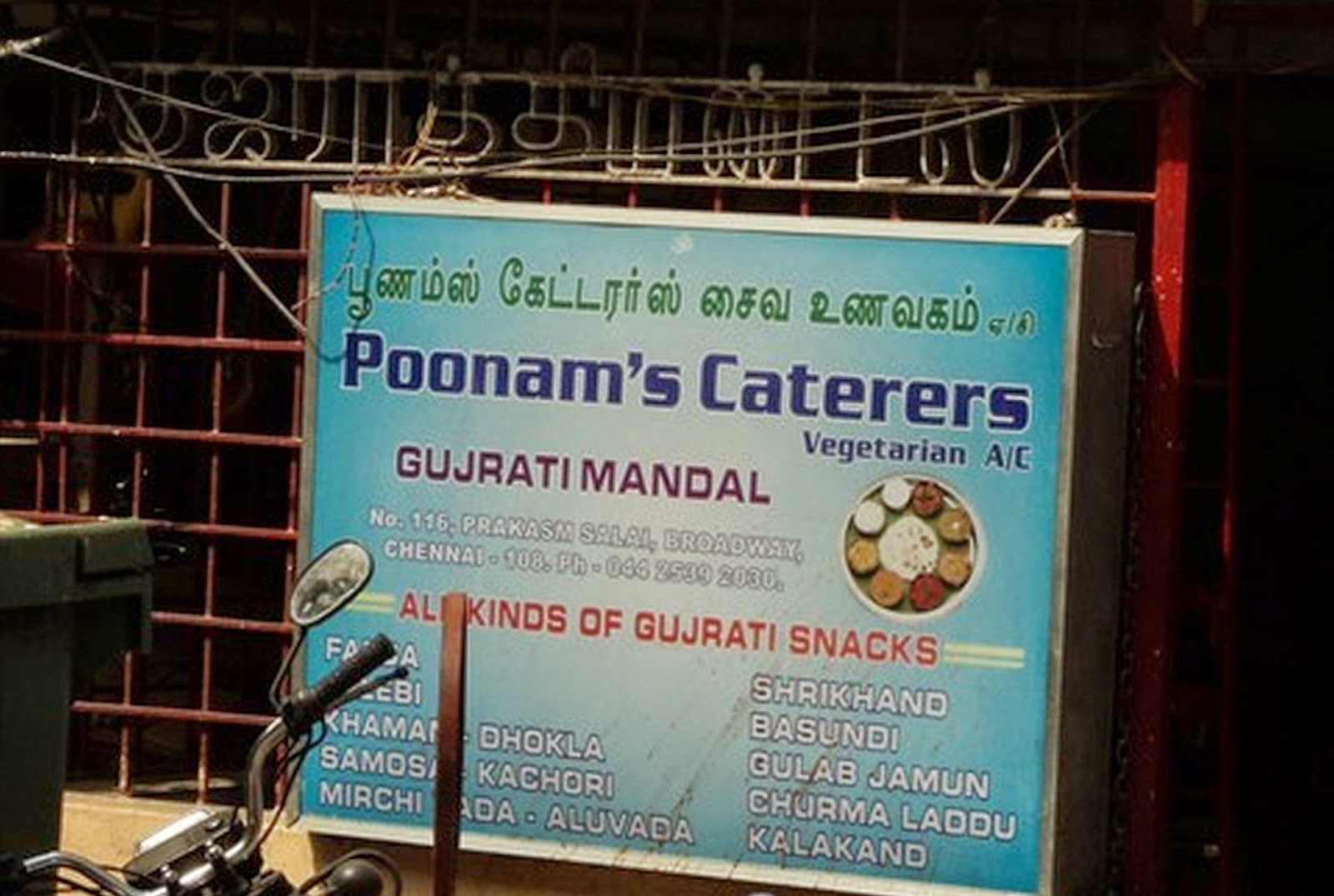
Poonam's Gujarati Bhojanalaya, Broadway, Chennai for authentic Gujarati food

Pooam's Gujarati Bhojanalaya, Broadway, Chennai
Gujarati Meals (Thali)
Poonam's Gujarati Bhojanalaya, Gijarati Mandal's the vegetarian restaurant, located (near High Court) at Broadway, North Chennai, is serving the Gujarati Thali from 1130 am. The place is certainly not as noisy and cramped as other Gujarati restaurants. However the seating space is limited and during weekdays you may have to wait to get your turn and the parking is difficult here. But during sundays the crowd is less and dining is comfortable.

 The "authentic" Gujarati food at Poonam's Gujarati Bhojanalaya in Chennai is a crowd favorite. Whether you go with family or friends, Poonam's is mostly a favourite place in Chennai for Gujarati food.

The menu consists of Jelibi, dal (lentils), gravy, two vegetarian dishes, Phool Wadi, roti (instead of roti try Thelpa at an extra cost of Rs.4.00 each), rice, rasam (Indian soup), mint chutney, pappad, pickle, salad and green chilly toast. The unlimited - eat as much as you want - meals cost just for Rs 75/- per head. You may like to have srikhand or basundhi or gulab jamun or aam rass (juice of ripe mango) at an additional cost of Rs.15.00 for each. The thalis are full and the dishes are subtly delicious. The plus point is generous and frequent refills with quick service. The Bhojanalaya also offer  Dal Halwa, Dhoklas, Fafda, Khandvi, wide variety of Milk Sweets  and  snacks for the Gujarati food lovers.

Address: 116, Gujarati Mandal, Near High Court, Prakasam Salai, Broadway, Chennai - 600108.
 
Timing: 11:00 am to 11:00 pm

Meals: Lunch, Thaali, Dinner

Thursday, May 22, 2014

Cenotaph of Madras Artillery Officer (1821 CE) at Kathipara Junction, Chennai


Lt Col. Sam Dalrymple of Madras Artillery: Cenotaph near Kathipara Junction
Source: The Hindu November 11, 2009
Ancestor Table
While traveling from Tambaram to Chennai, anyone can notice the whitewashed cenotaph with its prominent cupola bearing urn like finial near Kathipara road junction. There is every chance to miss this monument enclosed within the fence, since any one will be concerned only with the heavy traffic scenario. Kathipara's cloverleaf flyover and road junction  are located south of Guindy at the intersection of the Grand Southern Trunk Road (NH 45), Inner Ring Road, Mount Road and the Mount Poonamallee Road.

If you have not glanced this odd structure, just find out next time when you pass through the Kathipara junction. You may find it in between Kathipara junction and Mohite Stadium on Grand Southern Trunk (GST) Road, the national highway (NH-45). This piece of land including the cenotaph is maintained by the Indian army. Yes this cenotaph was built in 1821 in memory of Lieutenant Colonel Sam Dalrymple of Madras Artillery. Long back the Regimental center of the Madras artillery was located at the St Thomas Mount Cantonment and there was an Artillery Park wherein the present Mohite Stadium stands now.

'William Dalrymple is a British historian, Indologist and writer, art historian and curator, as well as a prominent broadcaster and critic'. Dalrymple first visited to Delhi in 26 January 1984 and started living in India on and off since 1989. Dalrymple visited to Chennai in November 2009 to promote his books. The Hindu newspaper covered his visit and published the front page story featuring William Dalrymple in the Thursday Metro Plus  supplement. The feature also published the interesting picture of W.Dalrymple at the Cenotaph of Lt.Col. Sam Dalrymple (one of his ancestors). He also recalled in an interview (Times of India) that several generations of his family had grown up in Madras. According to him the Madras Artillery officer died in May 1821 at the age of 49 years and this cenotaph was built by the fellow officers.

It is also a surprise to note that how this structure remains intact after the  cloverleaf flyover occupied much of the surrounding land. There was a move by NHAI to shift the cenotaph to the St Thomas Mount Cantonment adjacent to its present location as part of the flyover construction and this was also approved by the Ministry of Defence and even the military officials inspected to evaluate the strength of the structure and its ability to withstand the shift.

As the revised deadline of the flyover completion date forced the NHAI to drop the shifting plan and opted to give a face lift to the cenotaph. 

Reference:
  1. Dalrymple's Madras Connection by Karthik Bhatt. Madras Vignettes 11th November 2009
  2. In pursuit of the past By Parvathi Nayar The Hindu November 11, 2009
  3. The South Indian connection by S.Muthiah  The Hindu Jan 13, 2003