Showing posts with label Architecture. Show all posts

Wednesday, July 1, 2015

Ranganatha Swamy Temple, Pudupet (Komaleeswaranpet), Chennai

Ranganatha Swamy Temple, Pudupet (Komaleeswaranpet), Chennai (அரங்கநாதஸ்வாமி கோவில், புதுப்பேட்டை (கோமளீஸ்வரன்பேட்டை), சென்னை 

Temple 3 Tier Rajagopuram
Temple Viewed from Street
Temple

In Komaleeswaranpet, popularly known as Pudupet,  there is a beautiful temple dedicated to Ranganatha Swamy located in the Naicken Street near automobile spares and scrap market. From Komaleeswarar temple Ranganatha Swamy temple is just 1 km away. The area around the Komaleeswarar temple is known as Komaleeswaranpet. Chennai Photo walk participants covered this 500 years old Vaishnavite shrine walking down the lanes of Pudupet during their Retro-walk #19 (photo walk) : Pudupet on 28th June2015, Sunday, at 08.30am.


Dasavatara Door Panel
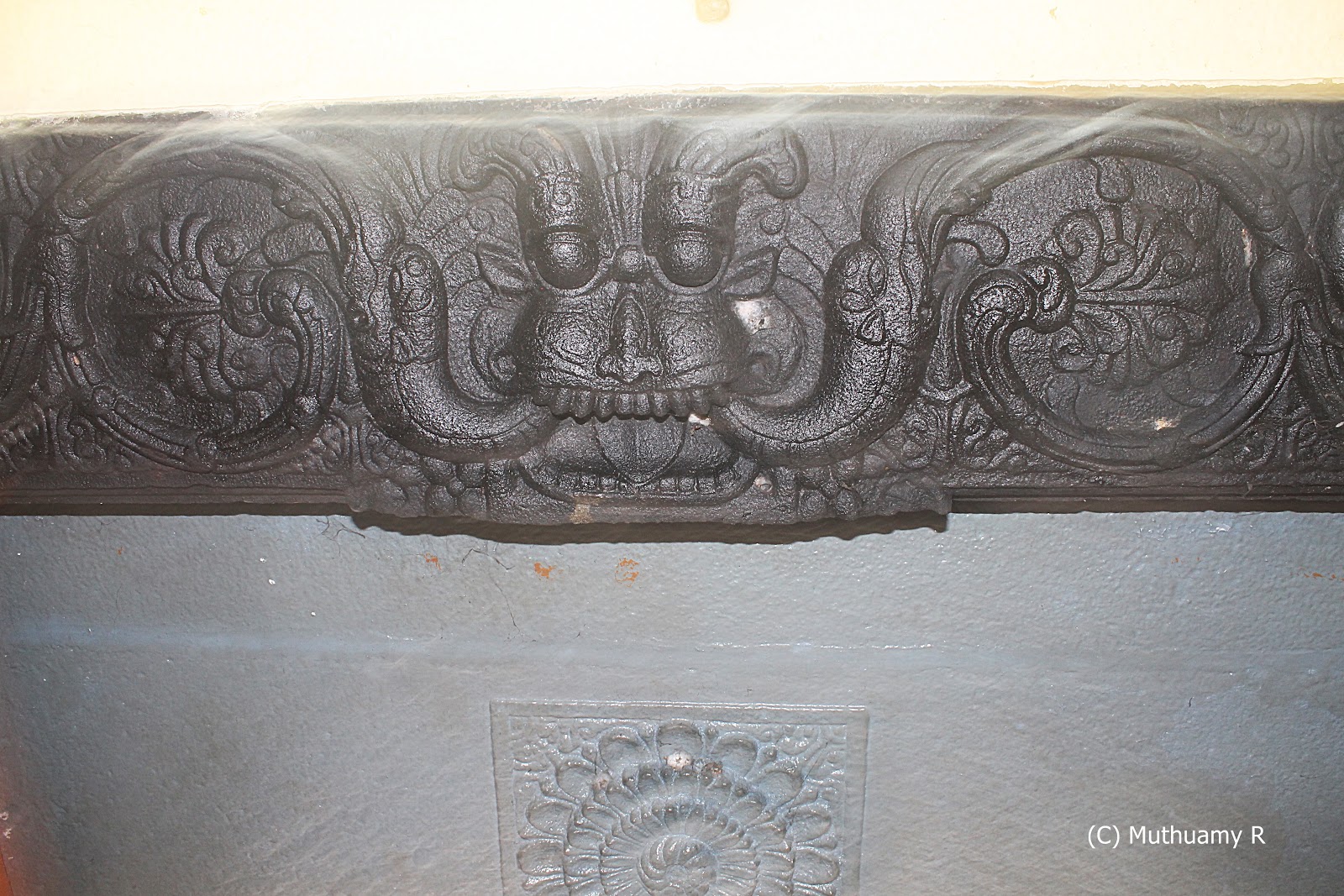
Kirtimukha
Main Sanctum

The north facing temple is entered through the three tiered rajagopuram. The presiding deity Lord Ranganatha Swamy with four hands, upper hands holding Shankha, Chakra and lower hands in in abhaya and varada hastas, appear reclining on Ananta Sesha, the celestial serpent. Laksmi Devi is sitting on a lotus flower on his chest. Lord Brahma is sitting on the lotus of creation, rising from the Lord's navel. Sitting at the Lord's feet are Sridevi and Bhudevi. 

Main Sanctum
Lord Parthasarathy
Dwarapalakas Jaya-Vijaya are guarding the sanctum. Also there are flagstaff and balipeeta before the sanctum.The single stone sanctum door frame is sculpted with bas reliefs madanikas (Salabhanjika–celestial damsels) and Dashavatara (ten incarnations) on side frame slabs and Kirtimukha decoration (demon faces) on the roof slab. The vimana under which the Lord enshrined is eka tala (single tier) vesara vimana. The base vimana structure (from adishtana to prastara) is made out of hard granite stones and with griva having mahanasika, shikara and four finials or kalasas. There is a pillared pavilion before the sanctum. The flight of three steps leading to  raised level fllooring. The floor are paved with modern tiles. The pillars are coated with paint. The bottom of the pillars have square base and the octogonal shape at the top. The Potika is the pushpa-potika (lotus-bud), characteristic of the Vijayanagar style. The pillars and prastara are coated with paint. All the pillar bases bear bas reliefs of incarnations of Lord Vishnu including Lord Parthasarathy of Tirualliekni. Garudazhvar appear in a small sanctum before the Lord Ranganathaswamy. 

Goddes Ranganayaki Shrine
Holy Feet
Goddess Sanctum

On the right side of the main sanctum goddess Ranganayaki appear in separate east facing shrine. The vimana under which the goddess enshrined is eka tala (single tier) Dravida vimana. The base vimana structure (from adishtana to prastara) is made out of hard granite stones and with square tala and octogonal griva having mahanasika, octogonal shikara and single finial or kalasa. There is a 16 pillared pavilion before the sanctum. The bottom and top of the pillars have square base and the octogonal shape at the middle. The Potika is the
Vaikundavasal
pushpa-potika (lotus-bud), characteristic of the Vijayanagar style.
Tirupati Venkatachalapati
At  the western corridor there are shrines for Lord Tirupati Venkatachalapathi (facing the rajagopuram), Sri Thumbikai Alavar (Vinayagar) (on the left) and Sri Gnana Anjaneyar and there are also shrines  for Chakrathalvar and Sri Yoga Narasimhar in the eastern corridor. At the southern corridor you can see the holy feet of Lord Ranganatha Swamy in the Sri Vaikundavasal Pavilion. Also there are shrines for Sri Annal (Soodikodutha Sudarkodi) and Sri Vikanasar and Sri Visvakenar as well as for 12 Alvars and 12 Acharyas. 

Sukra Sthalam

Main Sanctum Vimana
The prime deity Lord Ranganathaswamy is considered as the Lord for planet Venus (Sukra) and therefore shrine is known as the Sukra (Venus) Sthala. It is auspicious to offer prayers to the Lord on Fridays during Sukra Hora (6 am - 7 am) as well a on Wednesdays. The Pooja rituals follow the Agamic Sri Vaikasana Samprathaya.

Festivals

Goddess Sanctum Vimana
The annual Bramotsavam is celebrated in the Tamil month Panguni (Mar - Apr) for 10 days with Garudavaga seva and celestial wedding festivals. The Vaikunda Ekadasi is also celebrated with Lord's solemn procession through Parapathavasal. There are special poojas on all Saturdays in the Tamil month Purattasi (15 Aug - 15 Sep) and Laksharchana to Lord Ranganathaswami. The friday pooja rituals in the Tamil months Adi and Thai are auspicious for goddess Ranganayaki and Margazhi Neeradal festival for goddess Sri Andal.  

The temple is well maintained by Sri Loganatha Nayakkar family over the past five generations. 

Reference

  1. Namadhu Arasu Year 8 Malar 11, May 2015. Page 2.
  2. Retro-walk No19 : Pudupet – “Chor Bazaar” https://chennaiphotowalk.wordpress.com/2015/06/23/retro-walk-19-pudupet-chor-bazaar/

Wednesday, May 21, 2014

LIC's United India Building: Historical Landmark at Anna Salai

United India Building (old) situated behind LIC Building at 102, Anna Salai, Chennai, Tamil Nadu 600 002, India (1)
United India Building (old) situated behind LIC Building at 102, Anna Salai, Chennai, Tamil Nadu 600 002, India (2)
United India Building (old) situated behind LIC Building at 102, Anna Salai, Chennai, Tamil Nadu 600 002, India (3)

The LIC Building, a landmark in Anna Salai, houses the Zonal and Madras Divisional Office of LIC , comprise 13 storeys above ground and the basement and sub-basement below the ground. The colonial bungalow standing behind this LIC Building still remains with its heritage and history. The high ceiling structure has tall columns at the front, wide wooden paneling and ornate with stained glasses.

The entire premises measuring about 100 grounds was owned by Garratt, the tailoring firm. In 1883 the entire part and parcel of the land was sold to Lodge of Perfect Unanimity for Rs. 18,000. The Later in 1888, the Lodge sold a portion of the land measuring around 45 grounds and on this land Madras Publishing House was built. Lodge constructed the first floor to hold regular meetings in 1890. In 1905, the remaining 55 grounds were also sold to the District Grand Lodge (Apex body of Freemasonry) for Rs. 80,000. The Freemasons was shifted to its present premises in Egmore in 1916. At the same time the entire premises was sold to Kushaldoss Chaturbhujadoss, a Gujarati business personality for Rs.97,000. The old bungalow was rented to two tenants.  The first tenant was C Radhakrishna Chetty, who founded the Pioneer Laundry  in 1918. The second tenant was Murray & Co, premier auctioneers (established by two brothers Vedantam and Rajam in 1927) who occupied the premises in 1929. Later Kushaldoss Chaturbhujadoss sold it to United Insurance. The auctioneers has now shifted to 4, Norton Road, in Mandaveli. Now Pioneer Laundry remains there and the LIC has rented it out to the laundry people.

Saturday, May 3, 2014

Karnataka (Chikmagalur) Ornate Mansion: Reconstructed at Craft Village, Dakshinachitra, ECR Chennai


Karnataka House Architecture(Chikmagalur) at Craft Village, Dakshinachitra, ECR, Chennai

Dakshinachitra, “a living museum of art, architecture, crafts, and performing arts of South India” is constructed in 10 acres of land and located on the East Coast Road in Muttukadu i.e., 21 km south of Chennai. Created by the Chennai Crafts Foundation, Dakshinachitra is a work in progress Craft Village.

Dakshinachitra houses carefully recreated and showcases heritage structures, traditions and culture from the four southern Indian states of Andhra Pradesh, Karnataka, Kerala and Tamil Nadu. It is also a hub for performing arts, a retreat for artists, a learning center for students, an exhibition space, a place to visit for the culturally inclined tourist. 

I have captured this reconstructed heritage house from Karnataka and the heritage structure (Chikmagalur).

Address: East Coast Road, Muttukadu, Chingulpet District – 600 118. Landmark: next to MGM Dizee World;  Phone: 044 27472603 / 044 27472783
Visiting Hours: 10 am to 6pm Weekly Holiday: Tuesday (open on all national holidays except on Diwali Day).
How to Get There?: Dakshinachitra located on the scenic East Coast Road in Chennai. Access from Chennai: 21 kms South of Chennai on ECR or Access from Mahabalipuram: 25km on ECR.
By Road: City Bus Route Nos: 19, PP19, PP49 or Taxi

Wednesday, April 23, 2014

Evolution of Fort St.George 1939 (As Documented by Col.DM Reid) and Present Structure


Fort St.George Map 1939 Col.DM Reid
Post & Telegraphs: Special Cover 368th Madras Day Celebrations 22-08-2007
Wallajah Gate (Island Grounds) Fort St. George
Gate Used by Military Units at Fort St.George
North Gate Fort St. George
Bastions and Revelins of Fort St.George
At the Fort Museum, one can see maps and illustrations which documents the evolution of the fort and settlement over the centuries. Col. D.M.Reid (Douglas Muir Reid) prepared drawings of the fort with Madras volunteers. These drawings describe the evolution of this fort. He has also written a book title: 'The Story of Fort St. George.'

1687 -- Governor Elihu Yale erected the 45-m (148-ft) tall flagstaff to hoist the Union Jack for first time in India.  

1715 -- The Parade ground behind the Secretariat building was known as  Cornwallis Square.

1726 -- Marmalong Bridge, the first across the Adyar River. Built by the Armenian Coderjee Petrus Uscan.

1755 -- The Wallajah Bridge was constructed connecting the Wallajah Gate of the Fort to the Island. 

1825 -- Binny Bridge, named after John Binny, whose residence became the Imperial Hotel - now the Vivanta by Taj Connemara, also known as Commander-in-Chief’s Bridge, was constructed in Binny Road.

1829 -- Anderson Bridge, named after Dr. James Anderson, who had a botanic garden in the area once, was constructed across coovum and lies adjacent to Pantheon road signal. 

1840 -- Elphinstone Bridge constructed on River Adyar

1869 -- Napier Bridge,  which connects the entire stretch of the Marina with the Fort, was  constructed by Francis Napier, then Governor.  The Napier Bridge we know today, with its six bowstrings and ethereal lighting at night, was built in 1999.  

1910 -- A second floor over the wings and the magnificent Assembly Hall to the east with numerous black columns were added enhancing its facade.

1930 -- The low width North and South Sea Gates, which remain closed for a longer time, were estimated as too small and hence they were replaced with much wider structures.

1942 -- The small Centre Gate was not used for a longer duration and it was sealed with bricks. The closure also to protect the fort from threats posed by the Japanese.

When completed, Fort St. George was spread over 42 acres inside and over 60 acres outside the Fort Walls. The Fort had 3 principal gates, the “Sea Gate”, which has now been closed, the“Wallaja Gate” and “St. George Gate” apart from a few minor gates. The Gates were further strengthened by bastions, ravelins flanked by lunettes. A wet ditch was built all around the Fort as an added security measure.

Tamil Nadu State Government's Neo Classical Secretariat is visible to those who enter through Sea Gate


Fort St.George Borders:
  • Western side border: the Wall Tax Road and the Buckingham Canal
  • South side border: the North Fort Road on the eastern side and the General Hospital Road on the western side
  • Northern side border:  Basin Bridge Road and Old Jail Road
  • Eastern side border: the Rajaji Salai (First line beach road) and the Chennai Port
  • All the four sides are additionally bordered by railway lines of the Chennai Beach—Chengalpattu and Chennai Central—Chennai Beach sections.

The streets (some of streets and monuments are seen even till date) were named in the 17th Century when the Fort was a residential settlement, `White Town'. All the main streets were parallel to the coast and developed around the core, `The Castle' (The Fort).

Streets  within Fort St.George:

Sl.No. Name of the Street Thumbnail of the Street
1 Church Street
Location: Right side of the Fort House
2 North East Parade Street Location: Parade Grounds

3 Kings Barracks Location: CSD Canteen
4 Glouceter Street  Location: Fort Square
5 York Street
Location: Fort Square
6 Middle Street        Location: Fort Square
7 Charles and James Street
  Location: Clive House

8 St. Thomas Street
Location: Near Church Street
9
Oultry Street
Location: Near Parade Ground
10 Choultry Street

Location: Parade Ground
11 Inner street
Location: South West

12 Wallajah West Street  Location: South West
13 Saint George Curtain StreetLocation: St. Thomas Street
14 Inner George Gate Street
Location: West
15 Inner North Gate Road   Location: York Street

Monuments within Fort St.George, Esplanade and George (Black) Town:

Sl.No. Name of the Monument Thumbnail of the Monument
1 “Tamil Nadu State Government Secretariat (British East India Company Fort House)” . Location: Central Building
2 “Elihu Yale’s home” . Location: St.Thomas Street
3 St. Mary’s Church with tablets laid on the ground and enclosed by a compound and a buried wall  Location: Church Street
4 Clive’s house built in 1753  Location: Charles and James Street
5 “Arsenal” between Wellesley house and Clive’s House with shells and cannons piled together near the Gateway Block IV/1-12 and 14-18. (Wikimedia Commons)
It was designed by Colonel Patrick Ross and is presently being used by the military as their supply depot. 
Location: Charles and James Street
6 Wellesley house (Built in 1798), Block No. IV/13         Location: Charles and James Street
7 Big Warehouse, south of the Church Library (in Block No. II/7).
It is situated right opposite the Last House on Snob’s Alley and is in a complete state of disrepair with half of the roof structure having caved in. (Wikimedia Commons)
Location: St. Thomas Street
8 Chaplain’s house including portion which is the northern side of the old Wall II/1. (Wikimedia Commons)

Location: St. Thomas Street
9 Garrison Engineer’s Depot, Block No. IV

It is located opposite the Fort police station which is now in military use. 
Location: Charles and James Street
10 Guard room Block No. V Fort St. George, Chennai-9
11 King’s Barracks Block No. XXV  Location: Kings Barracks now Area CSD (Defence) canteen
12 Last house on the left of ‘Snobs Allay’ (Oldest house in the Fort with carved staircase) – Block No. I/1

It is now completely ruined with little trace left of its presence and is presently being restored by the ASI. (Courtesy: The sorry state of Fort St George Madras Heritage and Carnatic Music March 5, 2014 )
Location: St. Thomas Street
13 Nursing Sister’s House (Block No. I/3)

Located in a building to the north of the Last house and is in good condition. It is currently being used as residence by some of the church staff and nuns from St. Mary’s Church.

Location: St. Thomas Street
14 Old British Infantry Officer’s Mess (now housing the Fort Museum) Block XXXVI/2   Location: York Street
15 Ramparts, gates, bastions, Ravelins with vaulted chambers and water cisterns underneath; moat and defence walls all round with glacis to the extent of the existing barbed wire fence
16 Tomb of David Yale and Joseph Hymners in the compound of Law College, George Town

The proposed alignment and Chennai Metro Rail Station comes within 300 meters of the Tomb of David Yale and Joseph Hymners located inside Dr. Ambedkar Law College campus.
17 Old town Wall Tondiarpet, Chennai

Reference
  1.  Bridges of Madras - The concrete connect. Anusha Parthasarathy The Hindu Chennai April 16, 2013
  2. Exploring the Fort St. George: A neglected heritage complex by Anand Lakshmipathi Transparent Chennai April 1, 2013 
  3. List of Centrally Protected Monuments - State-wise, Tamil Nadu, Archaeological Survey of India Chennai Circle
  4. The sorry state of Fort St George Madras Heritage and Carnatic Music March 5, 2014 

Tuesday, April 15, 2014

Evolution of Fort St.George 1673 (As Documented by Col.DM Reid)


Col. DM Reid's Map showing the Fort St.George. Fort House at Centre

At the Fort Museum, Fort St.George, Chennai, one can see maps and illustrations which documents the evolution of the fort and settlement over the centuries. Col. D.M.Reid (Douglas Muir Reid) prepared drawings of the fort with Madras volunteers. These drawings describe the evolution of this fort. He has also written a book title: 'The Story of Fort St. George.'

The  Fort House was planned as a square enclosure and the factory was raised at the centre. Fort was so named as Fort St.George since the construction was completed on April 23rd, St George's Day. It became the company's eastern centre of government in 1652 and was blockaded by the Dutch in 1673.

1670s -- The Dutch invaded San Thome. The book Vestiges of Old Madras by H.D. Love informs  that when Dutch first arrived in 1673 it was not viewed as a threat. They came again from Sadras and Pulicat. “News arrived that 500 Hollanders had landed at Sadras and were marching on San Thome, and that Rijklof van Goens was bringing another force from Pulicat. On the 11th September, the Netherlanders were established on the site of the former Moslem camp, and two days later 500 to 600 Dutch, supported by Moorish cavalry, threatened the town.” Three days later, they set up camp at the Triplicane temple. A few months later San Thome fell.

The Fort House began to function as a trading warehouse in the early part of the 17th century. Much against the wishes of the East India Company, Fort St. George grew as the trade grew.

Reference:

Vestiges of Old Madras by H.D. Love Quot in The Sadras saga Anusha Parthasarathy The Hindu July 10, 2013

Monday, April 7, 2014

Mahabalipuram Light House


Mahabalipuram Light House
Light House View: Mahishasuramardhini Cave and Olakneshwar Temple (Uzhakku+Nei+Eshwar) Temple


Data on Mahabalipuram Light House
The Mahabalipuram Light House is located at the centre of Mamallapuram town on a small mountain nearer to the Mahishasura Mardhini cave temple. The Mahabalipuram Light House was constructed in 1894 by the British. It was constructed by the British government for guiding ships and to identify Mamallapuram coast for ships sailing in Bay of Bengal.

When Indian Prime Minister Mr.Rajiv Gandhi was assassinated in 1991, the authorities withdrew permission to visit the top of the Light House for tourists and public. After 20 years the public and tourists are being allowed to the top of Light House at Mamallapuram. Now tourists / public can enjoy the panoramic view of Mamallapuram town and enjoy the beauty from the top of the Light House in Mamallapuram. Lighthouse heritage museum, comprising heritage and marine museums is one more tourist attraction, added to Mahabalipuram Light House.

Saturday, April 5, 2014

Teacher Training College in Saidapet: Heritage Structure Demolished for Metro Rail work

 
The school building that has been pulled down - Picture Source: The Hindu Dt.
 
The Teacher Training College is one of the oldest such teacher training institutes in Asia. It was demolished for Metro Rail work - Picture Source: The Hindu

Teacher Training College in Saidapet,  one of the oldest teacher training institutes in Asia,  affirms its place in history. This historic college commenced its educational activity in 1856 as normal school in Vepery, Chennai. The first principal of this college was JT.Fowler, an English scholar. The college moved to Model Farm Campus in Saidapet in 1889. The alumni of this Teacher Training College include S.Radhakrishnan, Srinivasa Sastri and Ananthasayanam Iyengar.

Picture Source: The Hindu
The tablet unveiled at the centenary block of the Teacher Training College in Saidapet, in 1956 by  C. Subramaniam, minister of education, expresses its past. Despite its decrepitude and deserted condition by years,  the centenary building has been taken over by Mother Teresa Women's University in 1995 and was named as Institute of Advanced Studies in Education. It was also in use for five years and once portions of the building began to crumble the University was planning to demolish the structure to make way for new building.
 

Last year Chennai Metro Rail Ltd (CMRL) has completely demolished a heritage building in full  – one of the two tier semi-circular brick structure which was exhibiting resplendent colonial architecture  - tall madras roof, arched windows right along its periphery, and reminded us the Ice House at Marina. At present the other buildings are effectively concealed by the vast blue barricade raised by Chennai Metro Rail Ltd (CMRL).


It is learned from the  Justice E. Padmanabhan Committee Report that this centenary block  of the  Teacher Training College along with the adjoining buildings were declared as heritage structures and rightly classified as Grade I heritage building. The committee has observed that,  “Few of the buildings are maintained fairly while one is in serious deterioration.” Though the  plan to demolish other structures was stalled by the heritage enthusiasts, the future of the building remains uncertain.  It is also apt to quote the committee's report: “The committee with heavy heart points out that neither the public nor the administration nor the authorities are conscious of the value of maintaining the heritage buildings, places of historic importance or aesthetic value and popular places of worship, which is a disappointment. All of them will have to be educated and informed of the values of such historical and monumental buildings. The administration has to change its attitude on these aspects, by appropriate and stringent measures. The committee members are also pained to note that several heritage and ancient buildings have been brought down by the public as well as the authorities and they continue unabated.”


Reference
  1. Two Saidapet colleges  The Hindu CHENNAI, September 12, 2011
  2. Obscured from view and memory, heritage building has murky future, Asha Sridhar. The Hindu CHENNAI, August 13, 2012
  3. Day of demolitions on Anna Salai as the old make way for new Asha Sridhar. The Hindu CHENNAI, May 23, 2013
  4. Metro Rail continues bulldozing heritage  June 7, 2013  
  5. Bulldozing heritage The Hindu CHENNAI, June 10, 2013