Showing posts with label Tourist Attraction. Show all posts

Tuesday, April 8, 2014

Chokhi Dhani: Rajasthani Theme Village Near Chennai for Fun, Food and Entertainment


Chokhi Dhani: Collage

Do you want taste the authentic Rajasthani sweet dishes like jalebi and malpuaa or bajre ki roti (millet bread) and Lashun ki chutney (hot garlic paste)? Do you want to capture the spirit of Rajasthan and ensuring the perfect Rajasthani experience like Rajasthani Folk dance combined with rustic music or fun filled camel ride, bullock cart ride as well as games, puppet show or magic show or acrobatics? You will find everything at Chokhi Dhani, a must VIST unique Village Resort to taste the Rajasthani meethais and namkeen as well as watch the entire culture of Rajasthan at one place.

Chokhi Dhani, the one-stop destination combining the elements of ethnic culture and rustic and royal ambiance, brings colorful Rajasthani heritage with fun, food and entertainment. The fun filled theme village is located at NH-4, Near Queensland Theme Park, Kevlur Road, Tandalam, Sriperambudur, Chennai - 602 105, India, and its attractions are spread over 15 acres of land.  Thousand of people including local residents, domestic tourists and corporate clients  congregate  to experience the  right blend of traditions – modern amenities in typical ethnic environment.

Chokhi Dhani, set in ethnic Rajasthani village theme, brings you out the land of Rajasthan and let you to experience a ride on a camel or bullock cart, enjoy the Kalbelia (typical Rajasthani snake) dance. The village is dotted with huge lush green lawn for relaxation and  they have brought everything for you to relish: village bazaar and temple, village style bio scope or photo studio, mehendi art, jyotish and so on.

You Rajasthani food hunt ends at at the village theme restaurant, Sangri. Here you will find authentic Rajasthani vegetarian cuisine fit for royals and include Rajasthani meethai items - Jalebi, malpuaa; Rajasthani namkeen (snacks). There are lot more delicacies to experiment: typical Rajasthani breads - Roti-Gahuyari, Roti-Makkari, Roti-Bajarari; Sauce: churma (Dall), Bati (baked wheat ball), Dal-Chawal, Chawal (rice); Rajasthani famous curries - Sangri, Sag-Gattaro, Sag-Dal Pachhmelri, Sag-Kadi Besanri, Sag-Hariyalo,Chatni Lasna Ri and Chatni Dhana RI; some more items like Bura, Chat-Choulari, Makkhan-Dhani Ro, Ghee-Dhaniro, Chhachh, Papad and sweet or salt Lassi. Rajasthanis claim that their food is cooked using food cooked in desi ghee. 

Quick Facts:

Chokhi Dhani Chennai Address : NH-4, Near Queensland Theme Park, Kevlur Road, Tandalam, Sriperambudur, Chennai – 602 105

Chokhi Dhani Chennai Village Timing : 4pm to 11pm (All Days)

Chokhi Dhani Chennai Package Fee : Rs 600 for adult and Rs 400 for child (3-9 years)

Package includes Welcome Drink, Starter, Chaat, Dinner.

Activities : Flying Kites, Boating, Camel Ride, Cycling, Horse Car Ride, Bullock Cart Ride, Cycle Rickshaw Ride, Playing Marbles, Skill Games, Potter, Magic Show, Mehendi, Puppet Show, Rope Balancing, Snakes & Ladders, Maze, Head Massage, Fire Performers, Cultural Program and Ethnic Dance Activity.

Reference:
  1. Chokhi Dhani Dining & Cuisine http://www.chokhidhanimumbai.in/dining-cuisine.php
  2. Chokhi Dhani Village Fair and Dining http://www.chokhidhanichennai.com/

YouTube
Chocki Dhani Village Chennai by Suriyan Tv

Monday, March 31, 2014

Historical Significance of Buddhist Temple in Theosophical Society, Adyar, Chennai

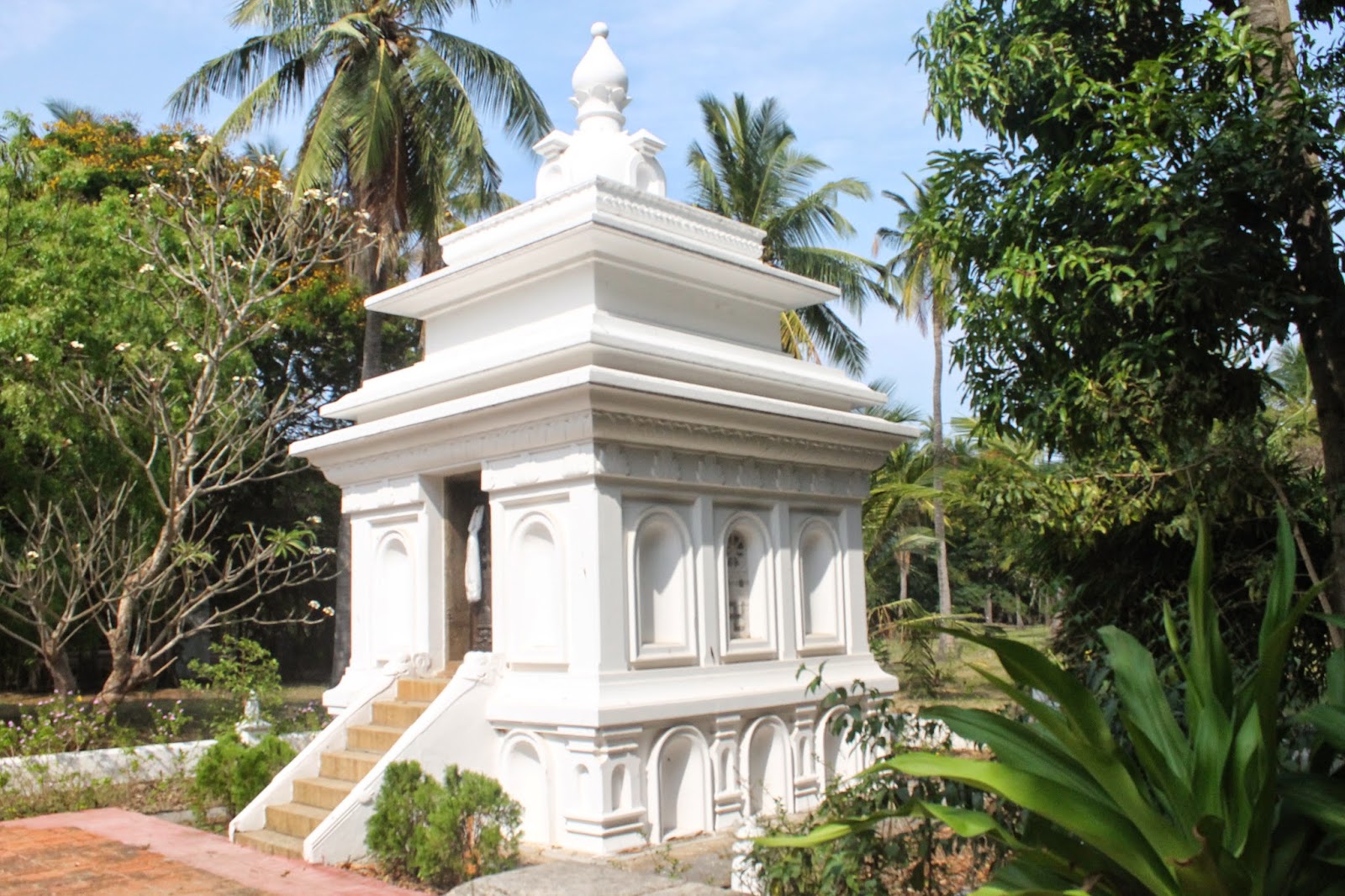
Buddhist Temple at Theosophical Society, Adyar, Chenna
Lily Pond
Bodhidharma Tablet

Buddhist Temple at Theosophical Society, Adytar, Chennai


It’s very uncommon to view the temple devoted to Buddha in Chennai. Apart from Buddha Vihar at Maha Bodhi Society of India at Kennet Lane Egmore, there is one small but elegant Buddha Temple stands, in a serene and tranquil environment, amidst the shady coconut grove  in Theosophical Society, Adyar.  

Though this white painted Buddhist Temple was contemplated in 1883, actually it was constructed under the guidance of Shri. Curuppumullage Jinarajadasa (1875–1953), the fourth President of the Theosophical Society and was consecrated during the Golden Jubilee convention of the Theosophical Society in December 1925. The temple architecture, according to Shri. C. Jinarajadasa, exhibits  "a combination of two styles, both contemporaneous, though one is at Buddha Gaya and the other in Nepal. The base of the shrine, with its rounded arches and pillars, is taken from Buddha Gaya, while the cornices and the dome are from a Buddhist temple in Nepal." 


Dr. Annie Besant arranged to bring the gray sandstone icon of Gautama Buddha from Eastern India and was sanctified at this temple. The splendidly carved wooden doors bear the lotus and Swastika motifs and the seven steps with elephant headed balustrades provide wonderful facade. Just close to the head of the icon of Buddha shows this inscription in Tibetan script:   'He taught the cause of all things as also the means of cessation'.

The vast splendid Bodhi Tree (ficus religiosa), seen before the shrine, is well known for its holy past i.e, the tree grown from the sapling brought from the mother banyan tree under which the Gautama Buddha attained Enlightenment. 
Marble Marble Plaque about Bodhi Tree
The tree was planted by Shri. C. Jinarajadasa to commemorate the the 75th anniversary of the Theosophical Society. It is all learned from the marble tablet found around this area. Also there is greenish lily pond facing the Buddha Temple. The antique Buddhist gong, commissioned near to the shrine, was striking sharply at six o' clock both in the morning and evening. 

The Zen Memorial Tablet, donated by the Institute of South Indian Buddhist Studies, was installed on October 5, 2009 at the corner of the Lily Pond. The tablet shows the figure of Bodhidharma, the holy Buddhist monk who instituted Zen to China in the 6th century and he was born in Kanchipuram, Tamil Nadu.


Reference:

  1. The Theosophical Society http://www.ts-adyar.org/content/home
  2. The Buddhist Shrine http://www.ts-adyar.org/content/buddhist-shrine

Friday, March 28, 2014

Dr. Annie Besant (Traffic Island) Park at Marina: Chennai Statues

Statue of Dr.Annie Besant at Dr.Annei Besant Park, Marina, Chennai 

Dr.Annie Besant Statue at Dr.Besant Road & Kamarajar Salai Junction, Marina, Chennai

Plaque of Dr.Annie Besant at Dr. Annie Besant Par, Marina, Chennai


Thematic Statue of a Boat Designed by Student of Government College of Arts and Crafts, Egmore, Chennai


The statue of Dr. Annie Besant (1847 – 1933), an Irish woman (who came to India in 1893 to serve for the cause of Indians and was also a social reformer in various spheres after having deeply inspired by the Indian religious tradition and she). is located in the Dr. Annie Besant Park (traffic island or triangular park) at junction of Dr.Besant Road and Kamarajar Salai near Ice House. Dr. Besant has played many roles in her lifetime and all of those activities were revolutionary for a woman to be doing. Besant’s name became a part of the Theosophical Society, Adyar and she spent most of her time on the betterment of society and even towards India’s freedom struggle.
A thematic statue of a boat, designed by the student of Government College of Arts and Crafts, Egmore, Chennai was installed in 2010. The Chennai Corporation has installed this thematic statue at this park as part of city’s beautification drive.

Wednesday, March 26, 2014

Palatial Chettinadu House: Located, Dismanled, Transported and Reconstructed at Dakshinachitra, ECR, Chennai


Typical House of Nagarathar of Chettinadu recreated at Dakshinachitra, ECR Chennai


Exterior showing திண்ணை [ tiṇṇai ] , a raised floor of the veranda outside the house , a pial of the Chettinadu House at Dakshinachitra
Interior showing திண்ணை [ tiṇṇai ] , a raised floor of the veranda inside the house , a pial of the Chettinadu House at Dakshinachitra
Interior showing the Veranda and the Open Courtyard of the Chettinadu House at Dakshinachitra
This picture shows the exterior facade as well as the interior of the house at Dakshinachitra which is the reconstruction of the common facade of smaller Nattukottai Chettiar merchant houses from 1850 through the 19th century.

This Nattukottai Chettiar merchant house was located at a village in Ariyakudi (near Karaikudi). The house has been transported brick by brick and reconstructed at this ‘heritage centre.’ A team comprising architecture students, carpenters and workers was set about measuring, photographing and carefully dismantling the house. The dismantled house was  then transported to Dakshinachitra (in 50 -60 lorries). According to Deborah Thyagarajan from Dakshinachitra “Reconstruction of the prototype often costs as much as three times the original value of the house.” Since approximately 30% of the timber required replacement. At Dakshinachitra,  the reconstruction was carried by highly skilled artisans and craftsmen experienced in Chettinadu traditional house construction . The house was reconstructed at a cost of Rs. 15 lakh with ornate doors and woodwork. Please note the outside columned veranda of Burmese teak.

It is very important to read the information provided at houses and exhibits to fully appreciate its cultural significance and observe details that might otherwise be overlooked.

Chettinad is the homeland of the Nattukottai Chettiars called the Nagarathars and they are a prosperous banking and business community. It is a place of rare charm, and a must visit destination.  You may find palatial mansions and huge houses embellished with marble and Burma teak. A map comprising the villages forming part of Chettinadu region comprising  seventy six villages located in Pudukottai, Pasumpom Muthuramalingam and Sivaganga districts of Tamil Nadu is shown here.
Map of Chettinadu Region. Village Names given in Tamil
Dakshinachitra – As name suggests, it means a “picture of South”. It is a heritage museum. Dakshinachitra is a non profit community service project of the Madras Craft foundation for the promotion and preservation of the cultures of the diverse people of India with emphasis on Tamil Nadu, Kerala, Andhra Pradesh and Karnataka.

Working days

It is open on all days except Tuesday. There is an Entry Fee of Rs. 100/-. Camera Charges are Extra. Credit cards are accepted at the counters.
How to Reach?

Dakshinachitra is a little out of the city (25 kilometers away from Chennai).  a 30 minute drive out of Chennai on the East Coast Road. While public buses ply the route, using private transport will save you a fair walk from the bus stand to the Centre.

Thursday, March 13, 2014

Panagal Raja Statue, Panagal Park, T.Nagar: Chennai Statues

Sir Panaganti Ramarayaningar KCIE, Raja of Panagal


Profile of Sir Panaganti Ramarayaningar KCIE, Raja of Panagal:

Panagal Raja Sir Panaganti Ramarayaningar KCIE, was regarded as an advocate of democracy and a staunch supporter of empowerment of the depressed classes. He was a zamindar of Kalahasti (Andhra Pradesh), a Justice Party leader and the Chief Minister or Premier of Madras Presidency (July 11, 1921 to 11 September 1923 and 19 November 1923 to 3 December 1926). 

Ramarayaningar was born in Kalahasti on July 9, 1866. He did his schooling in Triplicane High School Madras and obtained degrees in Sanskrit in Presidency College, law, philosophy and Dravidian languages. He started his career as a lecturer in Presidency College before plunging into politics. He was one of the founder-members of the Justice Party. He served as Minister of Local Self Government in Justice Party (1921-1926) and the President of Justice Party (1925 to 1928).

I have captured this picture - the statue of Panagal Raja at Panagal Park, T.Nagar, Chennai - during 61st Chennai Photowalk.  

Wednesday, February 19, 2014

Kapaleeswarar Temple, Mylapore, Chennai


Kapaleeswarar Temple Tower (Gopuram)

Kapaleeswarar Temple West Facing Shrine
Kapaleeswarar Temple - Spacious Corridor with Shrines for Minor Deities

Kapaleeswarar Temple, Mylapore

Prime Deity: Lord Kapaleeswarar (Lord Shiva)

Consort:  Sri Karpagambal.

Holy Tree: Punnai Tree

Agama Puja: Kameekam

The ancient Kapaleeshwarar temple, Mylapore is undoubtedly  a beautiful sample of classic Dravidian temple sculpture and architecture. The original temple was located near the sea but got submerged in the sea and the current temple was built around 350 years back by the rulers of Vijayanagara. Dedicated to lord Kapaleeswarar (lord Shiva) and his consort Devi Karpagambal, the temple has a wide temple tank, 37 m tall temple tower, spacious circumambulation path (prakaram), separate shrines for minor deities and also shrines in the niches of the vimanam walls. As per the legend Devi Karpagambal worshipped lord Kapaleeswarar in the form of a peacock (mayil = peacock) hence the town got the name Mylapore. Sage Kashyapar worhipped the lord. It is one of the seven Shiva (Sapthasthana) temples and one among the 40 temples that have west facing Shiva sanctums. Temple glorified by the saints Appar, Sundarar and Sambandar in Thevaram. During the annual festival (Arupathu Moovar Thiruvizha Brammotsavam) the bronze icons on 63 Nayanmars (63 Saiva saints) are taken in procession.
I had a pleasant photowalk in and around the temple on 12th January 2014 with group members during Mylapore festival 2014. Some pictures from the walk are shown above.

Ravana in Yakshagana: Music Dance Drama staged at Mylapore Festival 2014


KARTHAVEERYARJUNA KALAGA - Yakshagana - music dance drama was staged at Mylapore Kapaleeswarar Temple, Chennai on 12th January 2014 at 08.30 pm. by Sri Idagunji Mahaganapathi Yakshagana Mandali, Keremane Shivananda Hegde troupe as part of Mylapore Festival 2014.
 
The Yakshagana troupe Sri Idagunji Mahaganapathi Yakshagana Mandali Keremane (etd. in 1934) has completed 75 years and steadily striding towards its goal of experimenting and innovating the folk art form without affecting its traditional heritage. Since its inception the troupe has performed more than 8000 shows.

Tuesday, February 18, 2014

Vibheeshana in Yakshagana: Music Dance Drama staged at Mylapore Festival 2014

Karthaveeryarjuna Kalaga - Yakshagana - music dance drama was staged at Mylapore Kapaleeswarar Temple, Chennai on 12th January 2014 at 08.30 pm. by Sri Idagunji Mahaganapathi Yakshagana Mandali, Keremane Shivananda Hegde troupe as part of Mylapore Festival 2014.

Yakshagana (Yaksha Songs) is the musical dance drama (a traditional folk art form) of Karnataka theatre predominant in coastal and Malenadu regions of Karnataka, India.

It combines dance, music, dialogue, costume, make-up, and stage techniques with a unique style and form and portrays class of demigods in Hindu mythology. It usually depicts a story from the Hindu epics and puranas.

The actors wear resplendent costumes, head-dresses, and painted faces which they paint themselves. A Yakshagana artists also wearing pagaDe, one type of head-wear.


Facebook: https://www.facebook.com/photo.php?fbid=584914684916618&set=pb.510353505706070.-2207520000.1392646352.&type=3&theater

Monday, February 17, 2014

Chandraprabhu Swamy Temple, Sowcarpet, Chennai

The architectural inspiration of Chandraprabhu Swamy Temple at Mint treet, Sowcarpet, Chennai was derived from the Dilwara temples near Mt. Abu in Rajasthan.


Name: Chandraprabhu Swamy Temple aka Naya Jain Mandir

Category: Jain Temple

Location: 345, Mint Street. Sowcarpet, Chennai - 600079. Tamil Nadu, India.

Dedicated to: Chandraprabhu Swamy, the eight Jain Tirthankar.

Architecture: White marble Jain temple (built with the lime-and-soapstone and marble). This temple draws its architectural inspiration from the Dilwara temples near Mt. Abu in Rajasthan, India. Present temple is new. Previously in the same site was housing one of the oldest Jain temples of Chennai known as 'Swetambar Jain Temple.' The temple is located on an elevated plinth at the present site.

The main shrine has the marble idols of Chandraprabhu Swamy, the eight Jain Tirthankar (Jain holy teacher- 24 Tirthankaras are considered to be the creator of Jain religion) along with two disciples on his either sides. On the left side of the main shrine there is an image of Parshvanatha, the 23rd Tirthankara, while on the right side of the main shrine an idol of Adinath, the 1st Tirthankara, has been positioned. The temple also houses idols of minor Jain deities including Vijaya Yaksha, Vasupoojya Swamu,Muniswartha Swamu, Mallinath, Seemandhar Swamy, Jwala Devi, Padmavathy and Main Bhadra. The circumbulatory corridor also houses few Hindu deities. The temple also provide meditation hall (dhyam mandapa) in the basement.

Also Refer: http://www.trekearth.com/gallery/Asia/India/South/Tamil_Nadu/Chennai/photo1412944.htm
and Facebook https://www.facebook.com/photo.php?fbid=208077429374950&set=a.208403836008976.1073741842.100005180830717&type=3&theater