Showing posts with label Monument. Show all posts

Wednesday, May 21, 2014

LIC's United India Building: Historical Landmark at Anna Salai

United India Building (old) situated behind LIC Building at 102, Anna Salai, Chennai, Tamil Nadu 600 002, India (1)
United India Building (old) situated behind LIC Building at 102, Anna Salai, Chennai, Tamil Nadu 600 002, India (2)
United India Building (old) situated behind LIC Building at 102, Anna Salai, Chennai, Tamil Nadu 600 002, India (3)

The LIC Building, a landmark in Anna Salai, houses the Zonal and Madras Divisional Office of LIC , comprise 13 storeys above ground and the basement and sub-basement below the ground. The colonial bungalow standing behind this LIC Building still remains with its heritage and history. The high ceiling structure has tall columns at the front, wide wooden paneling and ornate with stained glasses.

The entire premises measuring about 100 grounds was owned by Garratt, the tailoring firm. In 1883 the entire part and parcel of the land was sold to Lodge of Perfect Unanimity for Rs. 18,000. The Later in 1888, the Lodge sold a portion of the land measuring around 45 grounds and on this land Madras Publishing House was built. Lodge constructed the first floor to hold regular meetings in 1890. In 1905, the remaining 55 grounds were also sold to the District Grand Lodge (Apex body of Freemasonry) for Rs. 80,000. The Freemasons was shifted to its present premises in Egmore in 1916. At the same time the entire premises was sold to Kushaldoss Chaturbhujadoss, a Gujarati business personality for Rs.97,000. The old bungalow was rented to two tenants.  The first tenant was C Radhakrishna Chetty, who founded the Pioneer Laundry  in 1918. The second tenant was Murray & Co, premier auctioneers (established by two brothers Vedantam and Rajam in 1927) who occupied the premises in 1929. Later Kushaldoss Chaturbhujadoss sold it to United Insurance. The auctioneers has now shifted to 4, Norton Road, in Mandaveli. Now Pioneer Laundry remains there and the LIC has rented it out to the laundry people.

Wednesday, April 23, 2014

Evolution of Fort St.George 1939 (As Documented by Col.DM Reid) and Present Structure


Fort St.George Map 1939 Col.DM Reid
Post & Telegraphs: Special Cover 368th Madras Day Celebrations 22-08-2007
Wallajah Gate (Island Grounds) Fort St. George
Gate Used by Military Units at Fort St.George
North Gate Fort St. George
Bastions and Revelins of Fort St.George
At the Fort Museum, one can see maps and illustrations which documents the evolution of the fort and settlement over the centuries. Col. D.M.Reid (Douglas Muir Reid) prepared drawings of the fort with Madras volunteers. These drawings describe the evolution of this fort. He has also written a book title: 'The Story of Fort St. George.'

1687 -- Governor Elihu Yale erected the 45-m (148-ft) tall flagstaff to hoist the Union Jack for first time in India.  

1715 -- The Parade ground behind the Secretariat building was known as  Cornwallis Square.

1726 -- Marmalong Bridge, the first across the Adyar River. Built by the Armenian Coderjee Petrus Uscan.

1755 -- The Wallajah Bridge was constructed connecting the Wallajah Gate of the Fort to the Island. 

1825 -- Binny Bridge, named after John Binny, whose residence became the Imperial Hotel - now the Vivanta by Taj Connemara, also known as Commander-in-Chief’s Bridge, was constructed in Binny Road.

1829 -- Anderson Bridge, named after Dr. James Anderson, who had a botanic garden in the area once, was constructed across coovum and lies adjacent to Pantheon road signal. 

1840 -- Elphinstone Bridge constructed on River Adyar

1869 -- Napier Bridge,  which connects the entire stretch of the Marina with the Fort, was  constructed by Francis Napier, then Governor.  The Napier Bridge we know today, with its six bowstrings and ethereal lighting at night, was built in 1999.  

1910 -- A second floor over the wings and the magnificent Assembly Hall to the east with numerous black columns were added enhancing its facade.

1930 -- The low width North and South Sea Gates, which remain closed for a longer time, were estimated as too small and hence they were replaced with much wider structures.

1942 -- The small Centre Gate was not used for a longer duration and it was sealed with bricks. The closure also to protect the fort from threats posed by the Japanese.

When completed, Fort St. George was spread over 42 acres inside and over 60 acres outside the Fort Walls. The Fort had 3 principal gates, the “Sea Gate”, which has now been closed, the“Wallaja Gate” and “St. George Gate” apart from a few minor gates. The Gates were further strengthened by bastions, ravelins flanked by lunettes. A wet ditch was built all around the Fort as an added security measure.

Tamil Nadu State Government's Neo Classical Secretariat is visible to those who enter through Sea Gate


Fort St.George Borders:
  • Western side border: the Wall Tax Road and the Buckingham Canal
  • South side border: the North Fort Road on the eastern side and the General Hospital Road on the western side
  • Northern side border:  Basin Bridge Road and Old Jail Road
  • Eastern side border: the Rajaji Salai (First line beach road) and the Chennai Port
  • All the four sides are additionally bordered by railway lines of the Chennai Beach—Chengalpattu and Chennai Central—Chennai Beach sections.

The streets (some of streets and monuments are seen even till date) were named in the 17th Century when the Fort was a residential settlement, `White Town'. All the main streets were parallel to the coast and developed around the core, `The Castle' (The Fort).

Streets  within Fort St.George:

Sl.No. Name of the Street Thumbnail of the Street
1 Church Street
Location: Right side of the Fort House
2 North East Parade Street Location: Parade Grounds

3 Kings Barracks Location: CSD Canteen
4 Glouceter Street  Location: Fort Square
5 York Street
Location: Fort Square
6 Middle Street        Location: Fort Square
7 Charles and James Street
  Location: Clive House

8 St. Thomas Street
Location: Near Church Street
9
Oultry Street
Location: Near Parade Ground
10 Choultry Street

Location: Parade Ground
11 Inner street
Location: South West

12 Wallajah West Street  Location: South West
13 Saint George Curtain StreetLocation: St. Thomas Street
14 Inner George Gate Street
Location: West
15 Inner North Gate Road   Location: York Street

Monuments within Fort St.George, Esplanade and George (Black) Town:

Sl.No. Name of the Monument Thumbnail of the Monument
1 “Tamil Nadu State Government Secretariat (British East India Company Fort House)” . Location: Central Building
2 “Elihu Yale’s home” . Location: St.Thomas Street
3 St. Mary’s Church with tablets laid on the ground and enclosed by a compound and a buried wall  Location: Church Street
4 Clive’s house built in 1753  Location: Charles and James Street
5 “Arsenal” between Wellesley house and Clive’s House with shells and cannons piled together near the Gateway Block IV/1-12 and 14-18. (Wikimedia Commons)
It was designed by Colonel Patrick Ross and is presently being used by the military as their supply depot. 
Location: Charles and James Street
6 Wellesley house (Built in 1798), Block No. IV/13         Location: Charles and James Street
7 Big Warehouse, south of the Church Library (in Block No. II/7).
It is situated right opposite the Last House on Snob’s Alley and is in a complete state of disrepair with half of the roof structure having caved in. (Wikimedia Commons)
Location: St. Thomas Street
8 Chaplain’s house including portion which is the northern side of the old Wall II/1. (Wikimedia Commons)

Location: St. Thomas Street
9 Garrison Engineer’s Depot, Block No. IV

It is located opposite the Fort police station which is now in military use. 
Location: Charles and James Street
10 Guard room Block No. V Fort St. George, Chennai-9
11 King’s Barracks Block No. XXV  Location: Kings Barracks now Area CSD (Defence) canteen
12 Last house on the left of ‘Snobs Allay’ (Oldest house in the Fort with carved staircase) – Block No. I/1

It is now completely ruined with little trace left of its presence and is presently being restored by the ASI. (Courtesy: The sorry state of Fort St George Madras Heritage and Carnatic Music March 5, 2014 )
Location: St. Thomas Street
13 Nursing Sister’s House (Block No. I/3)

Located in a building to the north of the Last house and is in good condition. It is currently being used as residence by some of the church staff and nuns from St. Mary’s Church.

Location: St. Thomas Street
14 Old British Infantry Officer’s Mess (now housing the Fort Museum) Block XXXVI/2   Location: York Street
15 Ramparts, gates, bastions, Ravelins with vaulted chambers and water cisterns underneath; moat and defence walls all round with glacis to the extent of the existing barbed wire fence
16 Tomb of David Yale and Joseph Hymners in the compound of Law College, George Town

The proposed alignment and Chennai Metro Rail Station comes within 300 meters of the Tomb of David Yale and Joseph Hymners located inside Dr. Ambedkar Law College campus.
17 Old town Wall Tondiarpet, Chennai

Reference
  1.  Bridges of Madras - The concrete connect. Anusha Parthasarathy The Hindu Chennai April 16, 2013
  2. Exploring the Fort St. George: A neglected heritage complex by Anand Lakshmipathi Transparent Chennai April 1, 2013 
  3. List of Centrally Protected Monuments - State-wise, Tamil Nadu, Archaeological Survey of India Chennai Circle
  4. The sorry state of Fort St George Madras Heritage and Carnatic Music March 5, 2014 

Monday, April 7, 2014

Mahabalipuram Light House


Mahabalipuram Light House
Light House View: Mahishasuramardhini Cave and Olakneshwar Temple (Uzhakku+Nei+Eshwar) Temple


Data on Mahabalipuram Light House
The Mahabalipuram Light House is located at the centre of Mamallapuram town on a small mountain nearer to the Mahishasura Mardhini cave temple. The Mahabalipuram Light House was constructed in 1894 by the British. It was constructed by the British government for guiding ships and to identify Mamallapuram coast for ships sailing in Bay of Bengal.

When Indian Prime Minister Mr.Rajiv Gandhi was assassinated in 1991, the authorities withdrew permission to visit the top of the Light House for tourists and public. After 20 years the public and tourists are being allowed to the top of Light House at Mamallapuram. Now tourists / public can enjoy the panoramic view of Mamallapuram town and enjoy the beauty from the top of the Light House in Mamallapuram. Lighthouse heritage museum, comprising heritage and marine museums is one more tourist attraction, added to Mahabalipuram Light House.

Monday, March 31, 2014

Historical Significance of Buddhist Temple in Theosophical Society, Adyar, Chennai

Buddhist Temple at Theosophical Society, Adyar, Chenna
Lily Pond
Bodhidharma Tablet

Buddhist Temple at Theosophical Society, Adytar, Chennai


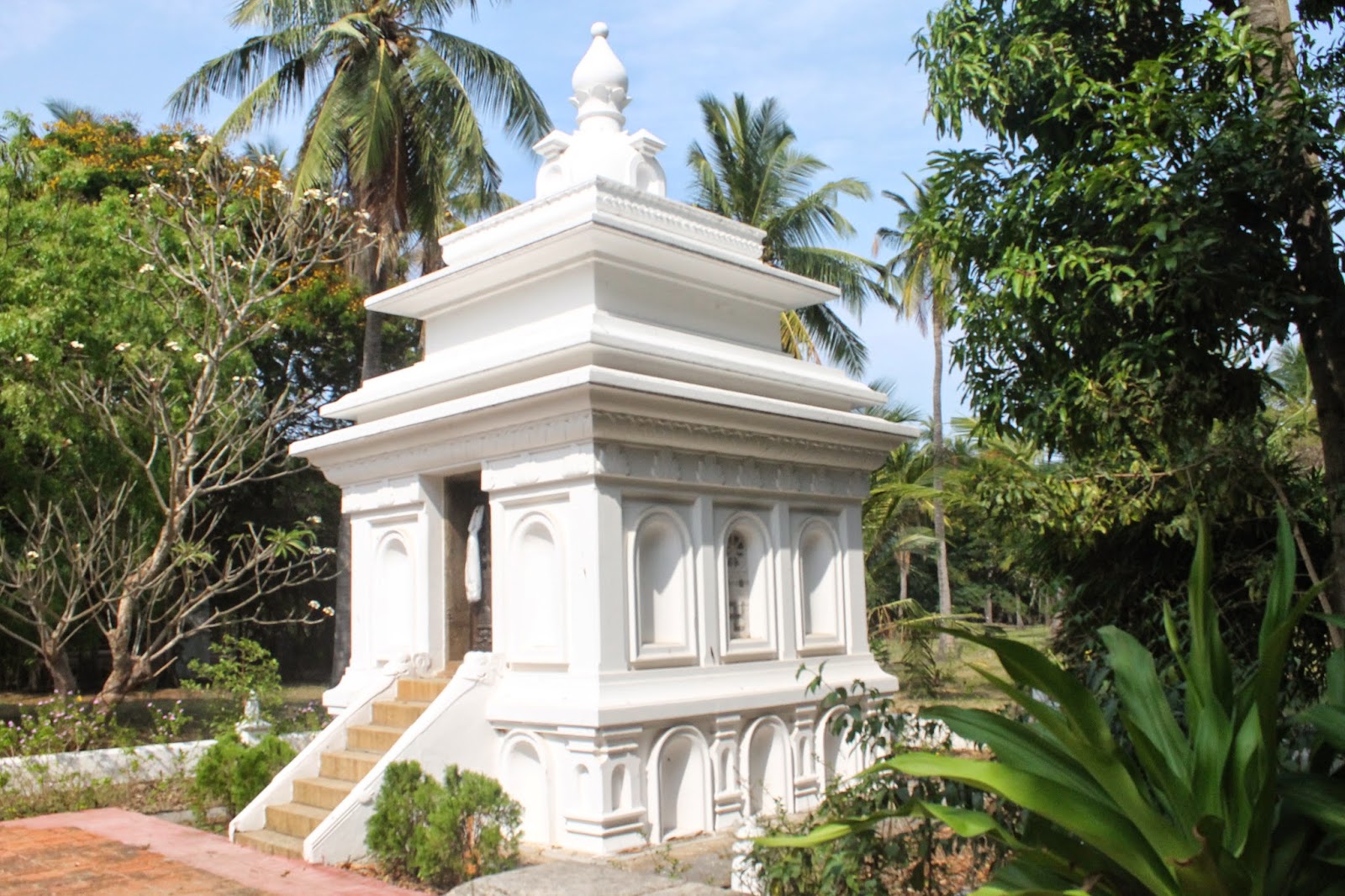
It’s very uncommon to view the temple devoted to Buddha in Chennai. Apart from Buddha Vihar at Maha Bodhi Society of India at Kennet Lane Egmore, there is one small but elegant Buddha Temple stands, in a serene and tranquil environment, amidst the shady coconut grove  in Theosophical Society, Adyar.  

Though this white painted Buddhist Temple was contemplated in 1883, actually it was constructed under the guidance of Shri. Curuppumullage Jinarajadasa (1875–1953), the fourth President of the Theosophical Society and was consecrated during the Golden Jubilee convention of the Theosophical Society in December 1925. The temple architecture, according to Shri. C. Jinarajadasa, exhibits  "a combination of two styles, both contemporaneous, though one is at Buddha Gaya and the other in Nepal. The base of the shrine, with its rounded arches and pillars, is taken from Buddha Gaya, while the cornices and the dome are from a Buddhist temple in Nepal." 


Dr. Annie Besant arranged to bring the gray sandstone icon of Gautama Buddha from Eastern India and was sanctified at this temple. The splendidly carved wooden doors bear the lotus and Swastika motifs and the seven steps with elephant headed balustrades provide wonderful facade. Just close to the head of the icon of Buddha shows this inscription in Tibetan script:   'He taught the cause of all things as also the means of cessation'.

The vast splendid Bodhi Tree (ficus religiosa), seen before the shrine, is well known for its holy past i.e, the tree grown from the sapling brought from the mother banyan tree under which the Gautama Buddha attained Enlightenment. 
Marble Marble Plaque about Bodhi Tree
The tree was planted by Shri. C. Jinarajadasa to commemorate the the 75th anniversary of the Theosophical Society. It is all learned from the marble tablet found around this area. Also there is greenish lily pond facing the Buddha Temple. The antique Buddhist gong, commissioned near to the shrine, was striking sharply at six o' clock both in the morning and evening. 

The Zen Memorial Tablet, donated by the Institute of South Indian Buddhist Studies, was installed on October 5, 2009 at the corner of the Lily Pond. The tablet shows the figure of Bodhidharma, the holy Buddhist monk who instituted Zen to China in the 6th century and he was born in Kanchipuram, Tamil Nadu.


Reference:

  1. The Theosophical Society http://www.ts-adyar.org/content/home
  2. The Buddhist Shrine http://www.ts-adyar.org/content/buddhist-shrine

Friday, March 28, 2014

Dr. Annie Besant (Traffic Island) Park at Marina: Chennai Statues

Statue of Dr.Annie Besant at Dr.Annei Besant Park, Marina, Chennai 

Dr.Annie Besant Statue at Dr.Besant Road & Kamarajar Salai Junction, Marina, Chennai

Plaque of Dr.Annie Besant at Dr. Annie Besant Par, Marina, Chennai


Thematic Statue of a Boat Designed by Student of Government College of Arts and Crafts, Egmore, Chennai


The statue of Dr. Annie Besant (1847 – 1933), an Irish woman (who came to India in 1893 to serve for the cause of Indians and was also a social reformer in various spheres after having deeply inspired by the Indian religious tradition and she). is located in the Dr. Annie Besant Park (traffic island or triangular park) at junction of Dr.Besant Road and Kamarajar Salai near Ice House. Dr. Besant has played many roles in her lifetime and all of those activities were revolutionary for a woman to be doing. Besant’s name became a part of the Theosophical Society, Adyar and she spent most of her time on the betterment of society and even towards India’s freedom struggle.
A thematic statue of a boat, designed by the student of Government College of Arts and Crafts, Egmore, Chennai was installed in 2010. The Chennai Corporation has installed this thematic statue at this park as part of city’s beautification drive.

Thursday, March 20, 2014

Metropolitan Magistrate Court, George Town: Indo-Saracenic Monuments of Chennai

Metropolitan Magistrate Court, Rajaji Salai, George Town, Chennai - Facade
 
 Metropolitan Magistrate Court, Rajaji Salai, George Town - Fine Indo Saracenic Architecture
 Metropolitan Magistrate Court, Rajaji Salai, George Town - heritage buildings of the British era
Metropolitan Magistrate Court, Rajaji Salai, George Town - Showing pattern of ceramic ornamentation
Chennai Metropolitan Magistrate Court (Rajaji Salai, Chennai) is the one of the subordinate courts functioning at the historic structure, built during the British rule in India.

 It is a court with lean strength of judicial officials (Metropolitan Magistrates) in the city. This architecturally decorated 3-storied building stands in between the two heritage buildings i.e, State Bank of India and the General Post Office and both of them are huge, complex solid structures. Often the architectural historians often points out this subtle contrast.

The rectangular shaped three-storeyed court building structure appear like a box. Like the other heritage buildings of the British era, the court building has the brick - jelly of Madras terrace roof. This kind of terrace was constructed using teak wood beam, (with or without) steel sections, high strength bricks (1”x3”x6”) and lime mortar. The British engineers played key role in laying such flat roof during British era.

The facade of the building exhibits a series of symmetrical pointed arches framed within rectangular panels. The most amazing pattern of ceramic ornamentation is unique and captivating. Among the British period construction, this is court building alone show such unique ceramic ornamentation pattern.

The court building, like the other heritage structures of Chennai, also confronting conservation oriented issues. A serious issue is the coal dust deposition on the walls and roofs. INTAH is involved in the restoration of the structure according to international historical structure preservation norms.