Showing posts with label French East India Company. Show all posts

Monday, May 5, 2014

Covelong Beach: Secluded Coromandel Coast Beach Near Chennai, Tamil Nadu

Taj Fisherman's Cove (View 1)
Taj Fisherman's Cove (View 2)
Sectional view (1) Public Beach at Covelong
Sectional view (2) Public Beach at Covelong
Covelong Dargah of Syedna Hazrat Tamim bin Ahmed Ansari Razi Allathu Thala Anthu, a Sufi Saint
Covelong (Kovalam) Beach Is the very clear and clean beach with the breathtakingly beautiful and tranquil ambiance and a popular destination among beach lovers. It is located 40 kilometres south of Chennai on the East Coast Road (scenic coast of Coromandel) en route to Mahabalipuram.  This less crowded and secluded beach, with radiating sun, deep blue sea and calm waters,  lovely white glistening sand, swaying palms and scenic views,  is the perfect hot spot  to relax and unwind.  Pack a picnic  and head off to Covelong and you will experience as if visiting a faraway fairytale land with a plethora of water sport activities like wind Surfing, water surfing and swimming. The enchanting beach also lies in proximity to Mahabalipuram and Crocodile Farm. There is a canal running parallel to the Bay of Bengal divides the beach from main-land.

Covelong, a  picturesque fishing village in the Coromandel coast , was developed in 1746 as the port by the Nawab of Carnatic, Saadat Ali for political and strategic purpose and soon it became the primary port. The French East India Company captured this port in 1746 and the French navy under the French General Laboudonnais  anchored till 1746. Lord Clive defeated the French in Carnatic war and the fort captured and promptly destroyed by British East India Company to prevent further French attacks in future.

A fort was built in Covelong by Dutch East India Company and the fort site has been converted into  Taj Fisherman's Cove, often regarded one among the top private luxury beach resort. The ancient Catholic Church is a must visit place on the beach. Also there is a dargah of Syedna Hazrat Tamim bin Ahmed Ansari Razi Allathu Thala Anthu, a Sufi Muslim saint.

Once you enter here,  you will learn the history and  vast array of geographic features; placidity and your body and mind positively charged with enthusiasm and energy and you may not willing to leave.

Location :

Located on the ECR Chennai Mahabalipuram State Highway.

Best Season:

Best time to visit Covelong beach is the months of November to February.

How to Get There - By Road:

The Covelong Beach is easily reachable by excellent road network that connects the town with the nearby cities. Buses and taxies are the most popular way of reaching Covelong beach from Chennai and other nearby cities.

Saturday, April 19, 2014

Evolution of Fort St.George 1758 (As Documented by Col.DM Reid)

Map of Fort St.George in 1758 by Col DM Reid
John Lodge Map 1747


Siege of Fort St.George December 1758 and February 1759
 
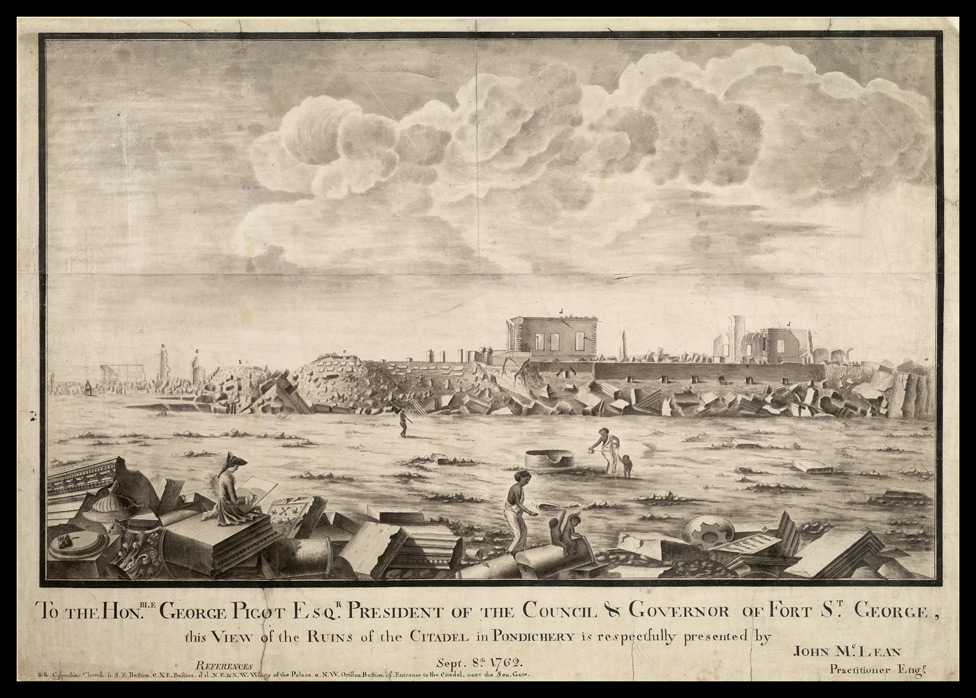
Siege of Pondicherry 1760
At the Fort Museum, one can see maps and illustrations which documents the evolution of the fort and settlement over the centuries. Col. D.M.Reid (Douglas Muir Reid) prepared drawings of the fort with Madras volunteers. These drawings describe the evolution of this fort. He has also written a book title: 'The Story of Fort St. George.'

1746 -- Battle of the Adyar River took place at Quibble Island, near the Adyar River on 29 October.
Quibble Island - Battle of Adyar River


1746 between the 300 men of the French East India Company led by Captain Paradis and a much larger force of 10,000 men belonging to Anwaruddin Muhammed Khan, the Nawab of the Carnatic. The Nawab claimed Madras from the French and  the French won and occupied Santhome. The Battle of the Adyar River acclaimed the advent of modern artillery warfare into the country's antiquated military system (cavalry). The battle led to their formation of the regiments that were to prove the nucleus of the Indian Army.

1746 - 1763 -- Three Carnatic Wars were a series of battles, primarily between the East India Companies of the British and French, for control of the trading ports of India.

1746–1748 -- The first Carnatic War was the fallout of the Austrian war of succession, in which France and England were in opposite camps.

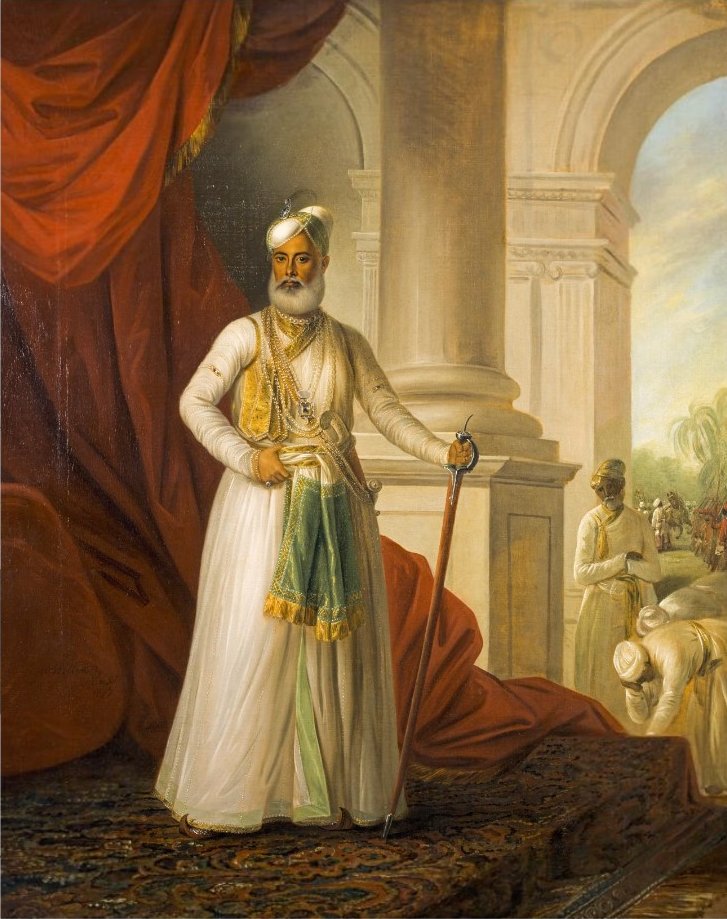
Mohammed Ali, Nawab of Arcot
1749–1754 -- The Second Carnatic War was closely linked with the dispute of succession in the Nizam Hyderabad and over the Nawabship of Carnatic. The French supported Chanda Sahib, who claimed the throne of Carnatic and the British supported Mohammed Ali. The troops of Robert Clive with the support of Marathas defeated Chanda Sahib.  Clive captures Arcot and the English emerge victorious. Mohammed Ali the Nawab of Arcot, became the undisputed leader. The Nawab of Arcot gifted Santhome to the English.
Kings Barracks Fort St.George

1755 - the King’s Barracks were built at Fort St.George to accommodate the bachelor officers and ranks of the East India Company Army. This King's Barracks was spreading over 10,000 sq.meters. A Grand Arsenal was added to store the ammunition required for the Carnatic Wars and some private property was acquired to build barracks for the soldiers.
1756 - To expand the Fort St.George, the small Elambore River flowing as the Western defence was diverted by filling Earth. The massive quantity of Earth was obtained by leveling the natural mound called “Hog’s Hill” (Narimedu) located further West. Cisterns were built to support water requirements for about 6000 men.

1757–1763 -- The Third Carnatic War was merely an echo of the Seven Years' War in Europe. The French Government sent a powerful army under the command of Thomas Arthur Comte de Lally to mitigate the influence of the British in India.

1752 -- Madras once again became of the seat of the Presidency.
1756 -- Period of hectic construction and reconstruction of the Fort, most of which remain today. Strengthening of the western front of the Fort and leveling of Hog Hill, the natural mound further west. King's Barracks built within the Fort to house the King's Regiment.

When war broke out with Great Britain, the French government chose Thomas Arthur Comte de Lally to command a French expedition to India.

1757-58 -- Demolition of the old Town Temple. Building of the northern face of the Fort St.George

1757 -- This expedition took a certain time to organize and finally it left Brest in May 1757.
1758 -- French expedition to India with Lally and staff reached Pondicherry on April 7 1758.
In May 1758, his troops captured Cuddalore.  

In December 1758 Lally laid siege to Fort St.George (siege of Madras). The Siege of Fort St.George commenced in December 1758 and continued for 67 days by French forces under the command of Lally during the Seven Years' War. The siege was lifted with the support of British fleet in February 1759. Comte Lally anchored his artillery at a remote place (present Parrys corner) and his French artillery managed to maintain uninterrupted shell fire for 46 days. As a result the fort was reduced to crash including the storeyed houses within the Fort. The British troops also retaliated 26,554 cannon balls and more than 200,000 cartridge rounds in defence of the town.

1759 -- Despite bombardment of Fort St. George over nine weeks, Lally and the French troops were  forced to raise the siege of Madras on February 16 - 17, 1759. The failure to capture Madras was a huge disappointment for the French and a massive setback to their campaign in India compounded by the later Battle of Wandiwash.

1760 -- On January 22 1760, Lally was defeated by Sir Eyre Coote, an Irishman born in Kilmallock, Co. Limerick,  at the Battle of Wandewash and finally surrendered to a British force. The British then undertook the Siege of Pondicherry. On September 3, a sortie conducted by Lally failed.

The English captured Pondicherry and Mahe, badly defeating the French. This defeat put an end to the French empire in India.

Execution of Comte de Lally
1766 -- 9 May, 1766 - Thomas Arthur Lally, Comte de Lally was executed for losing Pondicherry in India to the English.

Lally  was a courageous man and an able general, but his arrogance meant that he was not popular with his officers and was hated by his men. He despised native Indians and readily violated their customs and traditions. Initially he had some minor military successes, but his manner and demeanour were against him.

Reference
  1. Battle of Adyar The Hindu October 9, 2013
  2. Carnatic War, 1758-1761, British India India Netzone (Last updated 22/03/2012)
  3. Carnatic Wars 1746 - 1763 Heritage History
  4. Carnatic Wars (Wikipedia)
  5. Lally-Tollendal, Thomas Arthur Comte de Kronoskaf 
  6. Siege of Madras (Wikipedia)
  7. Siege of Madras, The Hindu
  8. The Irish Frenchman Muthiah S The Hindu Monday, Apr 06, 2009
  9. Thomas Arthur, comte de Lally (Wikipedia)

Friday, April 18, 2014

Evolution of Fort St.George 1746 (As Documented by Col.DM Reid)

Map Prepared by Col. DM Reid. Exhibits Evolutions and Developments in Fort St.George during 1711 - 1746
The French siege of Madras in 1746 and city surrendered in September 1746. (Wikimedia Commons)
Surrender of the City of Madras 1746 (Wikimedia Commons)

At the Fort Museum, one can see maps and illustrations which documents the evolution of the fort and settlement over the centuries. Col. D.M.Reid (Douglas Muir Reid) prepared drawings of the fort with Madras volunteers. These drawings describe the evolution of this fort. He has also written a book title: 'The Story of Fort St. George.'

1711 -- First Printing Press erected in Madras.

Removal of the inner walls surrounding the Fort House, its rubble used to form the Fort Square.

The trading rivalry among the East India Companies of Dutch and Portuguese made them to disappear from Indian markets. The East India Companies of British and French competed each other for Indian markets. Their rivalry had been growing in intensity.

1735 -- Chintadripet was formed.

1740 to 1763 -- In India the French and British forces locked in a conflict for economic and political fortune. In Southern India these two trading companies engaged in three Carnatic wars.

The French decision to participate in the War of the Austrian Succession displeased Britain and even triggered them to dispatch a Royal Navy squadron under Commodore Curtis Barnett to raid and harass French settlements in India.

1742 -- Veperi, Perimet, Perambur and Pudupakkam annexed to the city.

1945 -- Royal Navy attacked few French ships and break up commerce and the downfall of many top French merchants resulted.  The French also dispatched a similarly-sized fleet under the Bertrand-François Mahé de La Bourdonnais to counter attack British. There were inconclusive battles between these two fleets and the fleets were withdrawn to repair. Pondicherry became the French base.

1746 -- Santhome and Mylapore annexed to the City.

Bertrand François Mahé de La Bourdonnais
The French Governor of Pondicherry Dupleix authorised an attack on Madras. On 7 September 1746 -  Joseph Francois Dupleix troops and ships of La Bourdonnais engaged an expedition of French campaign designed to siege and capture Madras from the British Company.

Dupleix Jean Francois estampe
The French ships opened fire and French troops bombarded from both land and shore. The poor  fortifications of Madras were largely unable to resist such an attack.

On 9 September Nicholas Morse, the Governor of Madras sued for peace and offered the fort and warehouses for the French to take over and was seeking consent to retain the rest of the town under British control. The treaty emerged between La Bourdonnais and Nicholas Morse. Due to violent storm during October La Bourdonnais withdraw his fleet to Pondicherry and Dupleix took charge of the siege and brought the entire Fort under his control and was even willing to loot and destroy the Fort.  Many buildings were considerably damaged and most of them lost their upper floors. The St. Mary's Church was the only one that survived.

1746-49 -- For the next three years, Madras remained under French Governors, until 1749.  Mahe de la Bordannais served as acting Governor for a period of 22 days (From 10 September 1746  to 2 October 1746) and Jean-Jacques Duval d'Eprémesnil served between 2 October 1746 and August 1749. The French destroyed part of Black Town for security reasons.


Madras was handed over back to the British as per the Treaty of Aix-la-Chappele.