Showing posts with label Temple. Show all posts

Wednesday, September 16, 2015

Penneswaramadam Temple Inscription: How the Vira Ramanatha, Hoysala Ruler kept corruption at bay?


Sri Vedanayagi sameda Penneswara Nayanar temple
  • பென்னேஸ்வர மடம் கோயிலில் உள்ள கல்வெட்டை காட்டுகிறார் வரலாற்று ஆய்வாளர் சுகவன முருகன்.
    Sugavana Murugan, Freelance Archaeologist shows the Hoysala King Vira Ramanatha's inscription in Penneswaramadam Temple, Krishnagiri District, Tamil Nadu.
  • தலை துண்டிக்கப்பட்டவரின் உருவம் கொண்ட கல்வெட்டு.
    நவகண்டம் கல்வெட்டு.
The temples, during 13th century Hoysala rule, were degraded themselves to grossly corrupt practices. Vira Ramanatha (1253 to 1295 A.D.), the tenth Hoysala ruler showed  zero tolerance towards corruption. The Tamil Grantha inscription inscribed by the king in Penneswara Nayanar, Penneswaramadam clearly indicate how intolerant against corrupt practices and the violators of ethical framework. The Hoysala king has adopted anti-corruption measures in favor of his people.

Shri. Sugavana Murugan (pudhuezuthu), the scholar,  a government school teacher and also a freelance archaeologist, District Archaeology Centre of Kaveripattinam, Krishnagiri district has informed about the recording of the Tamil Grantha inscription by Shri. Su. Rajagopal and Shri. Su. Krishnamoorthy of the State Department of Archaeology.

The translation of the inscription in the Tamil Grantha script has been recorded by Su. Rajagopal and Su. Krishnamoorthy of the State Department of Archaeology, says Sugavana Murugan of the District Archaeology Centre. 
Penneswaramadam,  a panchayat village located on the bank of the South Pennar River  in Krishnagiri taluk Krishnagiri district PIN 635112. The village is approximately 100 kilometres  from Bangalore and.5 km from Kaveripattinam and 34 km from Dharmapuri. Penneswaramadam is geographically located at latitude 12 ° 23′0'' and longitude 12 ° 23′0''. Near by railway Stations are Bangarapet.

The 12th century Chola temple dedicated to Penneswara Nayanar (Lord Shiva) and his consort Sri Vedanayagi Amman.   The Penneswara Nayanar Shrine consists of a vimana, ardhamandapa and mukhamandapa. The vimana is a single tier structure with an adhishthana, pada, prastara, shikara, griva and stupi. The roofs of ardhamandapa and mukha mandapa are supported by vratta sthambas. The sanctum of the prime deity is facing east. The seven tier rajagopuram faces the south.

The vimana is surrounded by the cloister mandapa (thiruchurru malikai) with a row of pillars in the periphery. Subsidiary shrines for Vinayaka, Saptamatrikas, Surya and Chandra. The sanctum at the north-west corner of the temple houses the goddess Sri.Vedanayaki Amman. To the west there is a shrine for Rama, Lakshmana, Sita and Hanuman.

The Penneswara Nayanar temple also owns Navagandam panels. The specialty of the temple is that there is a practice of navagandam. Navagandam is the practice of individuals slicing their neck with a sword to the goddess. The supreme sacrifice often committed Kottravai, the war deity, involves in chopping off nine parts of one’s own body progressively. The individual offers his life for the welfare of the ruler and success in battles he leads.

Krishnagiri Region 

The present Krishnagiri and Dharmapuri district was known as 'Adhiayaman Nadu'. It was ruled by  Pallavas, Gangas, Nulambas, Cholas, Hoysalas, Vijaya Nagar Emperors, Bijapur Sultans, Wudayars of Mysore and Nayaks of Madurai. The regions including  'Krishnagiri', 'Hosur' and 'Uthangarai' were forming part of 'Eyil Nadu', 'Murasu Nadu' and 'Kowoor Nadu' respectively. Under Chola rule, Krishnagiri region was known as 'Nigarili Chola Mandlam' and 'Vidhugadhazhagi Nallur'. During 'Nulamba' rule it was called as 'Nulambadi.'  The 'Bara Mahal' Forts and the Krishnagiri region served as the west gateway of Tamil Nadu and defended the invasions. The Hoysala king Vira Ramanatha made "Kundani" a place in Krishnagiri District as his Head Quarters in 13th Century A.D. 

Inscriptions     

Over forty inscriptions have been discovered from this temple complex. They belonged to the reign of Hoysala, Chola and Vijayanagara kings. They have gifted gold, tax free land and other gifts to Penneswara Nayanar of Penneswaram. The inscription of Vira Narasimha, the Hoysala King records the land donation to the Pannai Nayanar by one Madurantaka Viranulamban Vairavan Vimalan. The land records also mention about lands located in Peruman Koyil Kollai, Thattankuttai, Mahadevan Kollai, Sirukkan Kollai, Puliyamadai etc.

An inscription of Vira Ramanatha Devarisa found in Tamil Grantha script - Tamil language on the wall of the Penneswara Nayanar temple in , Penneswaramadam is of great significance. It records the royal order issued by the Hoysala ruler Vira Ramanatha, dated regnal year 46.

"ஸ்ரீ வீரராமந்நாத தேவரீஸர்க்கு யாண்டு நாற்பத்தொன்றாவது உடையார் பெண்ணையாண்டார் மடத்தி லும் பெண்ணை நாயனார் தேவதானமான ஊர்களிலும் ஒரு அதிகாரியாதல் கணக்கர் காரியஞ் செய்வார்களாதல் கூசராதல் ஆரேனுமொருவர் வந்து விட்டது விடாமல் சோறு வேண்டுதல் மற்றேதேனும் நலிவுகள் செய்குதல் செய்தாருண்டாகில் தாங்களே அவர்களைத் தலையைஅறுத்துவிடவும் அப்படி செய்திலர் களாதல் தங்கள் தலைகளோடே போமென்னும்படிறெயப்புத்த பண்ணி இதுவே சாதனமாகக் கொண்டு ஆங்கு வந்து நலிந்தவர் களைத் தாங்களே ஆஞ்ஞை பண்ணிக் கொள்ளவும் சீ காரியமாகத்தாங்க . . . த. . . போதும் போன அமுதுபடிக் குடலாக ஸர்வ மானிய மாகக் குடுத்தோம். அனைத் தாயமு விட்டுக்கு . . .கூசர் உள்ளிட்டார் பையூரிலே இருக்கவும் சொன்னோம். இப்படியாதே இதுக்கு விலங்கனம் பன்னினவன் கெங்கைக் கரையில் குராற் பசுவைக் கொன்றான் பாவத்தைக் கொள்வான்" 

Meaning: "The record is dated in the 49th year of king Sri Viraramanatha Devarisar. Anybody seeking cooked food or indulging in other corrupt practices in Pennaiyaandaar madam (பெண்ணையாண்டார் மடம்) and its endowed land (Pennai Nayanar devadanamana oorgalilum - பெண்ணை நாயனார் தேவதானமான ஊர்களிலும்) shall be beheaded, and any official like Kannakkar, Adhigaarigal (அதிகாரியாதல் கணக்கர் காரியஞ் செய்வார்களாதல்) refusing to act on this order will face a similar fate.”   Registers an endowment of  land (ஸர்வ மானிய மாகக் குடுத்தோம்) for feeding the poor mendicants (நலிந்தவர்கள்). The order was strictly enforced. Whenever one violates the natural moral order established by the king, one sins and incur the sin of killing cow (குராற் பசு) on the bank of river Ganges.

Savulur Panchayat Union Middle School students have discovered a pre-historic site near Penneswara Nayanar  temple during April 2015. They have also collected artefacts dating back to 2000 years from the site near the temple.

In the Vijayanagar period, Madras Port became a well known port. This is evident from a Vijayanagar inscription found in Penneswaramadam, on the banks of the Pennar, to the South of Kaveripattinam. The inscription is dated July 21, 1367. It is about the digging of a canal in the time of Kampanna II. “This king’s conquests and victories in Tamil territory are also recorded in this inscription, and the names of ports, forts and villages on the East Coast, which he captured from Tondaiman, give us clues about Maadarasanpattanam,” says Rajavelu.

History of Hoysalas
  • Place        Karnataka
  • Period        10th to 14th Century
  • Language    Kannada
  • Religion    Hindu
  • Hoysala Kings: 1. Nripa Kama II (1000 to 1045 A.D.), 2. Hoysala Vinayaditya (1045 to 1098 A.D.), 3. Ereyanga (1098 to 1100 A.D.), 4. Veera Ballala I (1100 to 1108 A.D.), 5. Vishnuvardhana (1108 to 1142), 6. Narasimha I (1142 to 1173 A.D.), 7. Veera Ballala II (1173 to 1220 A.D.), 8. Vira Narasimha II (1220 to 1235 A.D.), 9. Vira Someshwara (1235 to 1253 A.D.),  10. Narasimha III and Vira Ramanatha (1253 to 1295) and 11.Veera Ballala III (1295 to 1342. A.D.).
The 346 year rule of the  Hoysala dynasty (1000 A.D. to 1346 A.D.) is looked at as the second most flourishing and mighty period in the Karnataka history next to the powerful Vijayanagara Empire. This South Indian Kannadiga empire ruled most of modern day state of Karnataka and Belur was their capital during initial 150 years and later moved to Halebid due to hostility and repeated invasions. Taking advantage of the warfare between the then Western Chalukyas and Kalachuri kingdoms, they also conquered the present day Karnataka and the fertile areas north of the Kaveri River delta of the present day Tamil Nadu. By 13th century, they governed most part of the of the present-day Karnataka, minor parts of Tamil Nadu and parts of western Andhra Pradesh in Deccan India. Narasimha II, the seventh Hoysala ruler conquered Tiruvannamalai in Tamil Naduto make it his winter capital. 
 
Vira Somesvara (1235 to 1253 A.D.), before his death bifurcated his kingdom between his two sons, Veera Narasimha and Vira Ramanatha. His sons, however, later fought a civil war. Vira Ramanatha confederated himself with Rajendra Chola Deva III. Both were later to be overpowered by Maravarman Kulasekara Pandiya, who impounded their territorial dominion. Vira Narasimha's successor was Ballala III aka Veera Vallalan, Emperor of the South (1291 - 1342 AD). Although still hostile, Ballala's succession was not disputed by Vira Ramanatha, thus Ballala was able to rule over a united Hoysala Kingdom until approximately by  1300 A.D.
Vira Ramanatha's accession to the Tamil districts took place about 1255 A.D. and his inscriptions of the 12th, 15th and in the 17th years, which correspond to 1267, 1270 and 1271 A.D. are found at Srirangam and Kannanur. The king attended to the checking of the revenue accounts in the 4th year of his reign; the communal repairs made to the Vanigan's well now known as Nalummulaikkeni at Tiruvellarai, whose walls it is stated, had sunk in on the four sides probably on account of heavy rains in the 8th year of the king, and exempted the tax on salt dealers at Tirumalavadi. He made to the temple of Sri Ranganatha at Srirangam, a gift of a gold crown set with jewels, two fly whisks with the handle of gold and a kalanji (betel pot). He was succeeded by his son Vira Viswanatha in 1293 - 94 A.D; after which the kingdom merged into then rising power of Vijayanagara Empire.  

These rulers were initially inspired by Jainism but from the Vishnuvardhana’s period onwards they were all Vaishnava Hindus and were great patrons of the temple architecture of Belur, Halebid and Somanathpura. The Hoysala dynasty is well remembered for the the hallmark of their temple architecture as well as for the exquisite workmanship on a massive scale in Belur, Halebid, Somanathapur, Arasikere and Amritapura in the Karnataka State and Tiruvannamalai in Tamil Nadu.

Reference:

  1. History of Krishnagiri District  http://www.krishnagiri.tn.nic.in/history.htm
  2. Hoyala Dynasty. Indian Mirror.com  http://www.indianmirror.com/dynasty/hoysaladynasty.html
  3. Madras is not alien by Suganthy Krishnamachary. The Hindu August 21, 2014
  4. Perils of corruption: a note from Hoysala ruler by PV Srividya. The Hindu  October 11, 2014
  5. லஞ்சம் வாங்கினாலும், கொடுத்தாலும் மரண தண்டனை விதித்த மன்னன்: 700 ஆண்டுகளுக்கு முந்தைய கல்வெட்டில் தகவல். எஸ்.கே.ரமேஷ். தி இந்து அக்டோபர்  10, 2014

Wednesday, July 1, 2015

Ranganatha Swamy Temple, Pudupet (Komaleeswaranpet), Chennai

Ranganatha Swamy Temple, Pudupet (Komaleeswaranpet), Chennai (அரங்கநாதஸ்வாமி கோவில், புதுப்பேட்டை (கோமளீஸ்வரன்பேட்டை), சென்னை 

Temple 3 Tier Rajagopuram
Temple Viewed from Street
Temple

In Komaleeswaranpet, popularly known as Pudupet,  there is a beautiful temple dedicated to Ranganatha Swamy located in the Naicken Street near automobile spares and scrap market. From Komaleeswarar temple Ranganatha Swamy temple is just 1 km away. The area around the Komaleeswarar temple is known as Komaleeswaranpet. Chennai Photo walk participants covered this 500 years old Vaishnavite shrine walking down the lanes of Pudupet during their Retro-walk #19 (photo walk) : Pudupet on 28th June2015, Sunday, at 08.30am.


Dasavatara Door Panel
Kirtimukha
Main Sanctum

The north facing temple is entered through the three tiered rajagopuram. The presiding deity Lord Ranganatha Swamy with four hands, upper hands holding Shankha, Chakra and lower hands in in abhaya and varada hastas, appear reclining on Ananta Sesha, the celestial serpent. Laksmi Devi is sitting on a lotus flower on his chest. Lord Brahma is sitting on the lotus of creation, rising from the Lord's navel. Sitting at the Lord's feet are Sridevi and Bhudevi. 

Main Sanctum
Lord Parthasarathy
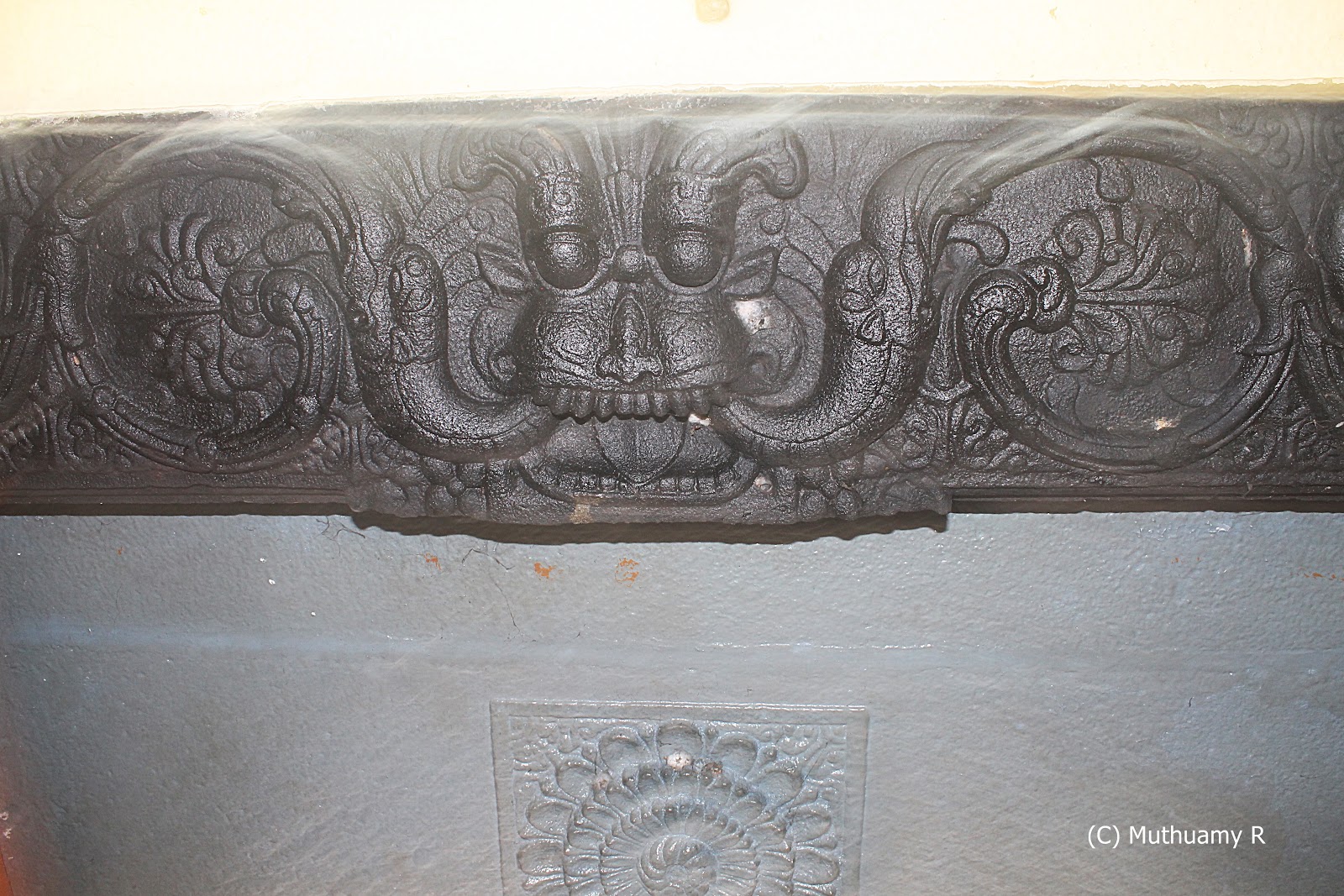
Dwarapalakas Jaya-Vijaya are guarding the sanctum. Also there are flagstaff and balipeeta before the sanctum.The single stone sanctum door frame is sculpted with bas reliefs madanikas (Salabhanjika–celestial damsels) and Dashavatara (ten incarnations) on side frame slabs and Kirtimukha decoration (demon faces) on the roof slab. The vimana under which the Lord enshrined is eka tala (single tier) vesara vimana. The base vimana structure (from adishtana to prastara) is made out of hard granite stones and with griva having mahanasika, shikara and four finials or kalasas. There is a pillared pavilion before the sanctum. The flight of three steps leading to  raised level fllooring. The floor are paved with modern tiles. The pillars are coated with paint. The bottom of the pillars have square base and the octogonal shape at the top. The Potika is the pushpa-potika (lotus-bud), characteristic of the Vijayanagar style. The pillars and prastara are coated with paint. All the pillar bases bear bas reliefs of incarnations of Lord Vishnu including Lord Parthasarathy of Tirualliekni. Garudazhvar appear in a small sanctum before the Lord Ranganathaswamy. 

Goddes Ranganayaki Shrine
Holy Feet
Goddess Sanctum

On the right side of the main sanctum goddess Ranganayaki appear in separate east facing shrine. The vimana under which the goddess enshrined is eka tala (single tier) Dravida vimana. The base vimana structure (from adishtana to prastara) is made out of hard granite stones and with square tala and octogonal griva having mahanasika, octogonal shikara and single finial or kalasa. There is a 16 pillared pavilion before the sanctum. The bottom and top of the pillars have square base and the octogonal shape at the middle. The Potika is the
Vaikundavasal
pushpa-potika (lotus-bud), characteristic of the Vijayanagar style.
Tirupati Venkatachalapati
At  the western corridor there are shrines for Lord Tirupati Venkatachalapathi (facing the rajagopuram), Sri Thumbikai Alavar (Vinayagar) (on the left) and Sri Gnana Anjaneyar and there are also shrines  for Chakrathalvar and Sri Yoga Narasimhar in the eastern corridor. At the southern corridor you can see the holy feet of Lord Ranganatha Swamy in the Sri Vaikundavasal Pavilion. Also there are shrines for Sri Annal (Soodikodutha Sudarkodi) and Sri Vikanasar and Sri Visvakenar as well as for 12 Alvars and 12 Acharyas. 

Sukra Sthalam

Main Sanctum Vimana
The prime deity Lord Ranganathaswamy is considered as the Lord for planet Venus (Sukra) and therefore shrine is known as the Sukra (Venus) Sthala. It is auspicious to offer prayers to the Lord on Fridays during Sukra Hora (6 am - 7 am) as well a on Wednesdays. The Pooja rituals follow the Agamic Sri Vaikasana Samprathaya.

Festivals

Goddess Sanctum Vimana
The annual Bramotsavam is celebrated in the Tamil month Panguni (Mar - Apr) for 10 days with Garudavaga seva and celestial wedding festivals. The Vaikunda Ekadasi is also celebrated with Lord's solemn procession through Parapathavasal. There are special poojas on all Saturdays in the Tamil month Purattasi (15 Aug - 15 Sep) and Laksharchana to Lord Ranganathaswami. The friday pooja rituals in the Tamil months Adi and Thai are auspicious for goddess Ranganayaki and Margazhi Neeradal festival for goddess Sri Andal.  

The temple is well maintained by Sri Loganatha Nayakkar family over the past five generations. 

Reference

  1. Namadhu Arasu Year 8 Malar 11, May 2015. Page 2.
  2. Retro-walk No19 : Pudupet – “Chor Bazaar” https://chennaiphotowalk.wordpress.com/2015/06/23/retro-walk-19-pudupet-chor-bazaar/

Monday, March 31, 2014

Historical Significance of Buddhist Temple in Theosophical Society, Adyar, Chennai

Buddhist Temple at Theosophical Society, Adyar, Chenna
Lily Pond
Bodhidharma Tablet

Buddhist Temple at Theosophical Society, Adytar, Chennai


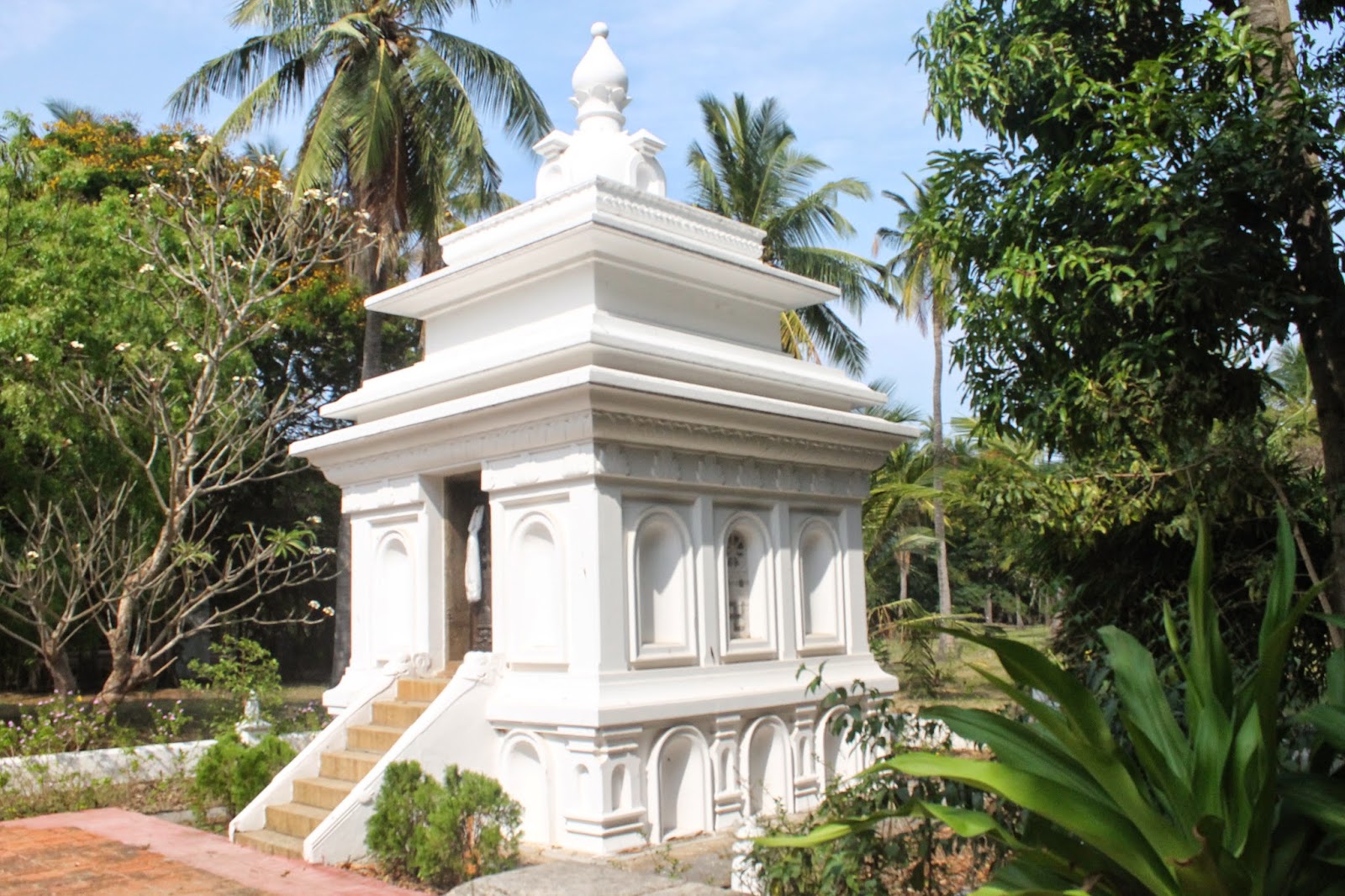
It’s very uncommon to view the temple devoted to Buddha in Chennai. Apart from Buddha Vihar at Maha Bodhi Society of India at Kennet Lane Egmore, there is one small but elegant Buddha Temple stands, in a serene and tranquil environment, amidst the shady coconut grove  in Theosophical Society, Adyar.  

Though this white painted Buddhist Temple was contemplated in 1883, actually it was constructed under the guidance of Shri. Curuppumullage Jinarajadasa (1875–1953), the fourth President of the Theosophical Society and was consecrated during the Golden Jubilee convention of the Theosophical Society in December 1925. The temple architecture, according to Shri. C. Jinarajadasa, exhibits  "a combination of two styles, both contemporaneous, though one is at Buddha Gaya and the other in Nepal. The base of the shrine, with its rounded arches and pillars, is taken from Buddha Gaya, while the cornices and the dome are from a Buddhist temple in Nepal." 


Dr. Annie Besant arranged to bring the gray sandstone icon of Gautama Buddha from Eastern India and was sanctified at this temple. The splendidly carved wooden doors bear the lotus and Swastika motifs and the seven steps with elephant headed balustrades provide wonderful facade. Just close to the head of the icon of Buddha shows this inscription in Tibetan script:   'He taught the cause of all things as also the means of cessation'.

The vast splendid Bodhi Tree (ficus religiosa), seen before the shrine, is well known for its holy past i.e, the tree grown from the sapling brought from the mother banyan tree under which the Gautama Buddha attained Enlightenment. 
Marble Marble Plaque about Bodhi Tree
The tree was planted by Shri. C. Jinarajadasa to commemorate the the 75th anniversary of the Theosophical Society. It is all learned from the marble tablet found around this area. Also there is greenish lily pond facing the Buddha Temple. The antique Buddhist gong, commissioned near to the shrine, was striking sharply at six o' clock both in the morning and evening. 

The Zen Memorial Tablet, donated by the Institute of South Indian Buddhist Studies, was installed on October 5, 2009 at the corner of the Lily Pond. The tablet shows the figure of Bodhidharma, the holy Buddhist monk who instituted Zen to China in the 6th century and he was born in Kanchipuram, Tamil Nadu.


Reference:

  1. The Theosophical Society http://www.ts-adyar.org/content/home
  2. The Buddhist Shrine http://www.ts-adyar.org/content/buddhist-shrine

Wednesday, February 19, 2014

Kapaleeswarar Temple, Mylapore, Chennai


Kapaleeswarar Temple Tower (Gopuram)

Kapaleeswarar Temple West Facing Shrine
Kapaleeswarar Temple - Spacious Corridor with Shrines for Minor Deities

Kapaleeswarar Temple, Mylapore

Prime Deity: Lord Kapaleeswarar (Lord Shiva)

Consort:  Sri Karpagambal.

Holy Tree: Punnai Tree

Agama Puja: Kameekam

The ancient Kapaleeshwarar temple, Mylapore is undoubtedly  a beautiful sample of classic Dravidian temple sculpture and architecture. The original temple was located near the sea but got submerged in the sea and the current temple was built around 350 years back by the rulers of Vijayanagara. Dedicated to lord Kapaleeswarar (lord Shiva) and his consort Devi Karpagambal, the temple has a wide temple tank, 37 m tall temple tower, spacious circumambulation path (prakaram), separate shrines for minor deities and also shrines in the niches of the vimanam walls. As per the legend Devi Karpagambal worshipped lord Kapaleeswarar in the form of a peacock (mayil = peacock) hence the town got the name Mylapore. Sage Kashyapar worhipped the lord. It is one of the seven Shiva (Sapthasthana) temples and one among the 40 temples that have west facing Shiva sanctums. Temple glorified by the saints Appar, Sundarar and Sambandar in Thevaram. During the annual festival (Arupathu Moovar Thiruvizha Brammotsavam) the bronze icons on 63 Nayanmars (63 Saiva saints) are taken in procession.
I had a pleasant photowalk in and around the temple on 12th January 2014 with group members during Mylapore festival 2014. Some pictures from the walk are shown above.

Ravana in Yakshagana: Music Dance Drama staged at Mylapore Festival 2014


KARTHAVEERYARJUNA KALAGA - Yakshagana - music dance drama was staged at Mylapore Kapaleeswarar Temple, Chennai on 12th January 2014 at 08.30 pm. by Sri Idagunji Mahaganapathi Yakshagana Mandali, Keremane Shivananda Hegde troupe as part of Mylapore Festival 2014.
 
The Yakshagana troupe Sri Idagunji Mahaganapathi Yakshagana Mandali Keremane (etd. in 1934) has completed 75 years and steadily striding towards its goal of experimenting and innovating the folk art form without affecting its traditional heritage. Since its inception the troupe has performed more than 8000 shows.

Tuesday, February 18, 2014

Vibheeshana in Yakshagana: Music Dance Drama staged at Mylapore Festival 2014

Karthaveeryarjuna Kalaga - Yakshagana - music dance drama was staged at Mylapore Kapaleeswarar Temple, Chennai on 12th January 2014 at 08.30 pm. by Sri Idagunji Mahaganapathi Yakshagana Mandali, Keremane Shivananda Hegde troupe as part of Mylapore Festival 2014.

Yakshagana (Yaksha Songs) is the musical dance drama (a traditional folk art form) of Karnataka theatre predominant in coastal and Malenadu regions of Karnataka, India.

It combines dance, music, dialogue, costume, make-up, and stage techniques with a unique style and form and portrays class of demigods in Hindu mythology. It usually depicts a story from the Hindu epics and puranas.

The actors wear resplendent costumes, head-dresses, and painted faces which they paint themselves. A Yakshagana artists also wearing pagaDe, one type of head-wear.


Facebook: https://www.facebook.com/photo.php?fbid=584914684916618&set=pb.510353505706070.-2207520000.1392646352.&type=3&theater

Monday, February 17, 2014

Chandraprabhu Swamy Temple, Sowcarpet, Chennai

The architectural inspiration of Chandraprabhu Swamy Temple at Mint treet, Sowcarpet, Chennai was derived from the Dilwara temples near Mt. Abu in Rajasthan.


Name: Chandraprabhu Swamy Temple aka Naya Jain Mandir

Category: Jain Temple

Location: 345, Mint Street. Sowcarpet, Chennai - 600079. Tamil Nadu, India.

Dedicated to: Chandraprabhu Swamy, the eight Jain Tirthankar.

Architecture: White marble Jain temple (built with the lime-and-soapstone and marble). This temple draws its architectural inspiration from the Dilwara temples near Mt. Abu in Rajasthan, India. Present temple is new. Previously in the same site was housing one of the oldest Jain temples of Chennai known as 'Swetambar Jain Temple.' The temple is located on an elevated plinth at the present site.

The main shrine has the marble idols of Chandraprabhu Swamy, the eight Jain Tirthankar (Jain holy teacher- 24 Tirthankaras are considered to be the creator of Jain religion) along with two disciples on his either sides. On the left side of the main shrine there is an image of Parshvanatha, the 23rd Tirthankara, while on the right side of the main shrine an idol of Adinath, the 1st Tirthankara, has been positioned. The temple also houses idols of minor Jain deities including Vijaya Yaksha, Vasupoojya Swamu,Muniswartha Swamu, Mallinath, Seemandhar Swamy, Jwala Devi, Padmavathy and Main Bhadra. The circumbulatory corridor also houses few Hindu deities. The temple also provide meditation hall (dhyam mandapa) in the basement.

Also Refer: http://www.trekearth.com/gallery/Asia/India/South/Tamil_Nadu/Chennai/photo1412944.htm
and Facebook https://www.facebook.com/photo.php?fbid=208077429374950&set=a.208403836008976.1073741842.100005180830717&type=3&theater